Military


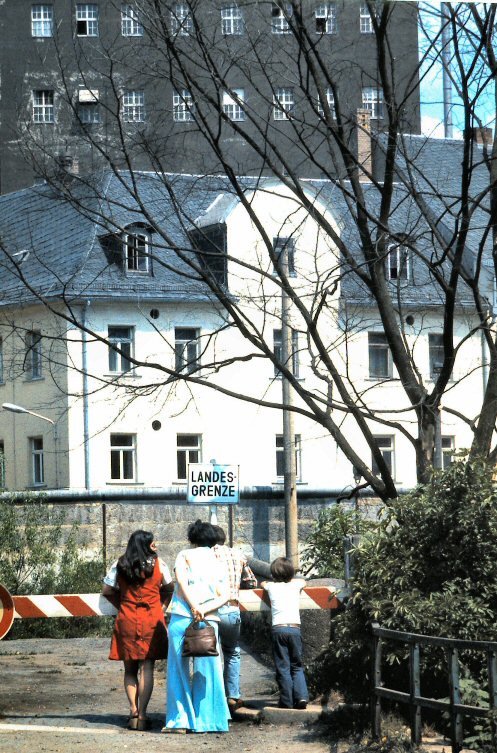
1978: Me, in the red dress, and my son, on the right, with friends, looking across the Saale river into East Germany, near the Bavarian town of Hof.

1978: Me, in the red dress, and my son, on the right, with friends, looking across the Saale river into East Germany, near the Bavarian town of Hof.

German filmmakers are making films depicting life during the 40-year existence of the Deutsche Demokratische Republik, the DDR, East Germany.  Apparently, it’s a space that has been left vacant for the most part.  To quote an NPR review of a recent film, Barbara, a German entry for the Oscars,

“The West kind of got there and said, ‘Now you can be happy.’ … I mean it’s 40 years of their lives. … They can’t be in vain. And no one asked.”

I’ve seen two films about life in the former East Germany after it was “former,” when the life was the life after the fall of the totalitarian Communist regimes in Eastern Europe:  Schulze Gets the Blues and Goodbye Lenin.

Barbara is the first film I’ve watched from the Eastern point of view about how people managed during those 40 years on the other side of the fence.  At the time, no one on this side of the fence imagined they’d ever be a former enemy.

One of my pet peeves is stories, whether written or performed, that have incorrect military information.  Some of the wrong information is simple, such as my current peeve, and some of it is illogical made-up-stuff.

Tonight’s irritation is with an episode of “Unforgettable.”  In the story, a Veterans Administration doctor has been asked by Unforgettable’s main character about a veteran who is a person of interest in a murder (the Crazed Veteran is always a popular character if you need a military person in your story).   The veteran in question would be fluent in Pashto, a language in Afghanistan.  The doctor replied to the detective that it would take several tours in Afghanistan for a soldier to become fluent in Pashto, and then says that she does have a client in counseling who fits the description — a corporal.

Insert rant about ‘if you plan on writing about something, learn the basic information about it.’

In the Army, a corporal is an E4, a junior enlisted rank.  If this person were a corporal he wouldn’t have had enough time in service to easily become fluent in Pashto, unless he’d been demoted multiple times.  Pashto is a language that the Foreign Service Institute rates as a level 2 or 3 language, levels that take between 34 – 48 weeks of full-time study for basic proficiency. Unless a person were being trained as a linguist, it is unlikely that the Army would invest the time for the training.

Which brings us to another point.  The photo of the uniformed ‘person of interest’ shows a relatively long-haired white-bread man (for today’s military) in an Army uniform, wearing infantry brass backed by a light blue disc.  An infantryman in Afghanistan is not surprising, however, an infantryman wouldn’t have linguistic training.  If an infantryman had acquired fluency in Pashto — either from multiple tours in Afghanistan or from language training — he would have been in the Army long enough to be more than a corporal.  Still, for story-purposes, a Pashto-spouting bad guy is more menacing than your average veteran.

Then there’s the fiction that he’s a corporal.  In today’s Army, very few military occupational specialties (MOSes — ie, ‘jobs’) use the rank of corporal.  An E4 in the infantry would be a specialist unless he were filling a leadership position.

Specialist is a designation retained from when the Army had ranks from Specialist Fourth Class up to Specialist Seventh Class alongside the NCO ranks of the same pay grades.  In today’s Army, and of the specialist ranks, only the E4-Specialist rank remains.  I’d say this story character wouldn’t be a corporal because, as I said before, if he’d been in the Army long enough to be fluent in Pashto, he was probably demoted more than once and wouldn’t be leader material.

Now if this service member were a Marine, then the corporal rank is appropriate — although, as a Pashto-speaking-E4, he still would be suffering from the time-in-service problem concerning the language fluency.

The holes in this one story point are large enough to drive a truck through.

Writers — and producers and directors — if you’re going to use the Crazed Veteran character in your stories, at least do the poor guy the honor of getting his backstory straight.

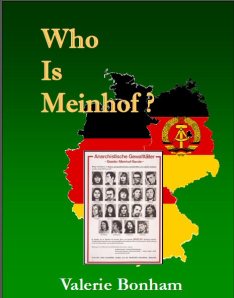
2013 07 Jul 29 Who Is Meinhof cover

Staff Sergeant Barb Hoskins is newly arrived in West Germany and,
after another night of jet-lagged lying-in-bed (she can hardly call it ‘sleep’),
is searching for breakfast at her new home/place of work.
She finds nothing to eat and then the phone rings
(and rings, and rings).  The co-worker who was to have
remained at the office is nowhere to be found and,
after answering the phone, Barb winds up working
to keep both her and her new boss out of hot water.
Barb finds herself wondering who the real enemy is
— the Soviets across the border
or the terrorists driving around the countryside?

Behind the story:

(story will remain available for about two weeks)

Link has been removed

Apropos of nothing more than needing a subject about which to write, the dilemma of where I’m from came to mind. Not having a well-defined place of origin is one of those small social inconveniences like having eyes of two different colors, a haircut for the wrong gender (too long or too short), or very out of date eyeglasses frames. None of it matters, but people find a way to comment on it anyhow.

I have a slight, non-standard American accent. No matter where I live I don’t sound like I’m “from around here.” Of course, people understand me but some vowels are “off,” or I’ll use a word in a wrong way. If, after a few moments of talk, the people I’m speaking with have any curiosity about it, I’m asked where I’m from, and I hesitate. It seems like an easy enough question to answer. After all, how can you not know where you’re from?

If I’m being a nosy parker, most people to whom I’ve posed the same question will usually say where they were born, or where they grew up. They know where home is. Maybe they moved around the area, perhaps from house to house in the same town, so they know the local roads, the television stations, the sport teams and famous players, the old restaurants and high school hangouts, and not only the weather but the long-time weather forecasters as well. They can say, “I’m from …” without any hesitation.

When I am asked where I’m from, I usually say, “The Air Force.” It often takes my questioner a couple of beats to figure out what I said and my reply usually gets a half-hearted laugh. I should probably just pick one place that I’ve lived before, but then I get asked something specific about it and I hesitate again while explaining how I only lived there a few years a long time ago. Either way, people look at me as if I’m making stuff up.

~~~~~

I was born in a “temporary” WWII-era military hospital on an Air Force base on the east coast of the U.S., and for three months lived in the city of my birth, which wasn’t where either of my parents were from. Just like everyone else I’ve carried my birthplace identifier with me as long as I can remember, carefully writing it on any form demanding the information, but not having any feeling for what it was like there other than what I’ve seen in the few photos in our album from those three months, or from impressions given by newspaper pictures (it’s a famous city). I often feel like a fraud by claiming I’m a native daughter because my knowledge of the place is that of a person who has read a tourist brochure. I can describe famous landmarks but that’s about the extent of my knowledge. I know more about Paris, the one in France, than I do about where I was born. It’s a trait I share with all my children, none of whom remember where they spent the earliest days of their babyhoods.

While I was still a babe in arms, my dad sailed away on a Navy ship to England after traveling with me and Mom to St. Louis so she and I could stay with my godparents, my dad’s brother and his wife. We have pictures of my cousins playing with me, but it’s like looking at old photos of them playing with a neighbor’s baby.

A quarter of the way around the world, Dad settled in to postwar-London and after four months found a house to rent. Once my father had a place for us to stay, the Air Force allowed Mom and me to board a Navy ship to sail to Europe with a boatload of other dependents, including a family who would live down the street from us a decade or so later, but who, at the time, were just names on the ship’s manifest and of no more importance to us than the rest of the dependents trekking to other countries to be reunited with husbands and fathers who’d also managed to find apartments, houses or quarters.

1951 04 Apr dependents arriving in Europe

A few years after sailing to England, my parents and I sailed back to the U.S., with my dad stuck again in the hold of yet one more old Navy ship, while Mom and I were in a small cabin. Fed up with being shipped in steerage merely because he was enlisted and not an officer, Dad laid down good money for first class tickets on a train to St. Louis. There he bought a light green Chrysler station wagon and we drove the rest of the way to South Dakota where I spent my elementary school years. In the natural course of things, I acquired a brother and a sister.

To me, my brother and my sister were actual South Dakotans – they had memories of the place we lived when they were born — but I was from someplace else, a place more foreign to me than some actual foreign places. Reducing my sense of being from any one place, I couldn’t even claim the country where I’d made my own first memories.

Then we moved again, but this time it was wonderful and I didn’t care where I was from — I’d be from there.

I spent junior high and the beginning of high school in beautifully rainy and sunny Bermuda. It was like a permanent vacation, what with swimming from a friend’s back porch, sailing in St. George’s Harbour and water skiing, but eventually reality reared its head. Even though I wanted to be a minor league diddlybopper on a blue Mobylette from jus’ do’n de rood, b’y, I wasn’t from there. I could be made to leave. When we left England, I didn’t know what it meant to leave home and it was an adventure. This time, I knew, and the adventure wasn’t as exciting.

By that time, the military transport of people had switched to airplanes and these planes eventually took us to the town where I’d graduate from the remainder of high school, but not with any sense of belonging. While working on the senior class float for the homecoming parade, one of my classmates looked at me, cocked her head like a curious dog, and asked, “When did you get here?” By then, I’d been in that school two years. If Dad hadn’t retired, it would be almost time to leave and be the new kid again at another Air Force base.

Despite the wild, blue yonder coloring my entire life, by the time I graduated from school I was a civilian even though I didn’t feel like one. I still addressed adult men by rank and last name, and could sing the Air Force song as well as the songs of the other services. My natural vocabulary included words, phrases and acronyms such as: housing list, quarters, and civil engineers, which all had to do with where we lived, or rather, where we used to live. Getting to our (former) quarters often included front or side gates in the base fence, and the guard shack.

The traditional words about where my dad had worked included SAC and MATS, headquarters, bomb wing and bomb squadron, bivouac, NCOIC, AFSC, and my dad’s service number.

Recreational words, which as the dependent of a retiree I could still use, included service club, base pool and base beach, base library, snack bar, BX, Class Six (for Dad), and the all-important ID card. Grocery shopping was done at the commissary. Eating out meant an outing to the NCO Club. Going on vacation, which had meant furlough or leave, involved signing out and signing in, both of which invariably happened either just after or just before midnight to make the most of traveling time.

Traveling to other places involved TDY (Dad went by himself) or PCS (we went, too) and may have included a B-2 bag. People stayed in places called a VOQ, a BOQ, barracks or a guest house.

Airplane stuff was indicated by flight suit, flight line, prop-job, B-52, KC-135, C-130, C-141, fighter pilots, afterburners, Blue Angels and the Thunderbirds.

Scary things were alerts, sirens, and evacuation. Scarier things were loud booms out of nowhere, chaplains arriving at quarters, and Mount Kit Carson which was someplace in Washington state and the site of a fireball from a plane flying into a mountain.

Still, normal, everyday routine outweighed the scary stuff and my transition to civilian life didn’t last long because I joined the Army. My brother and sister chose the Navy and Air Force. Eventually, I became the wife of a soldier and passed along the legacy of Brathood to my children. I’m not “from” any one place, and neither are they.

I was born one place, lived the longest in another, graduated from school someplace else, and my favorite home was yet a different place.

Where am I from?

The Air Force.
So, the USAREUR G2 reunion is over, the organizer’s wife has loaded the banner into their car, and many of us had a relatively communal breakfast before we all scatter again to the corners of the country. My husband and I said our goodbyes to the organizer’s wife (“behind every great man, there’s a woman …”), the organizer (who kindly autographed his Secrets of the Cold War book for me), and friends of friends (who’ve become people with whom we want to stay in touch).

We traded email addresses with a married couple, the husband having had overlapping co-workers with my husband, and our new friend hinted at a book he, too, was writing.  I gave him an arch look, as you do when something wonderful this way comes, and said, “Mine takes place in Fulda.  Where is yours set?”  My question was prompted in part from an overheard comment from another of our breakfast companions about his proposed novel, as well as hearing a talk at last night’s banquet from the author of the Yankee Doodle Spies series.  People close to “spy stuff” during the Cold War are feeling the need to write.

My friend’s story is set in Wiesbaden, Germany, during the Berlin crisis in the early ’60s, an event whose seriousness was compounded by the Cuban missile crisis.  My own experience of that time was that my mom and my siblings and I were in the U.S., still at the Air Force base my dad just left, while my dad was at another base in Bermuda trying to find us a house. I remember feeling as if the Russians had physically erected an oceanic wall between me and my dad, just as they were really done to the  people of Berlin. To a child, this was overwhelmingly scary — “scary” being the best I could do to express my feelings as I had yet to learn just how horrific adult threats can be.

My stories, also in Germany, begin about a decade after my friend’s story. The American military forces were dealing not only with the Soviet Union across the inner border between the two Germanies, but also with Soviet-supported terrorism within West Germany, a terrorism that was spreading across Europe and the Middle East like a plague. Everyday people knew that the terrorists had elements of the American military in the crosshairs of its sights. Clearly, those of us who were there have stories to tell.

Our new friend and I talked about a longing to preserve a period about which little is written (neither one of us have had much luck with library research), but yet which is a time that consumed the better part of our adult lives:  the “spy vs. spy” era in Europe. The difference being the actual “spy vs. spy” and the fictional depiction of it comes mostly from the gap between the workaday perspective of filling in the puzzle pieces of actual espionage, and James Bond style glitz. The trick will be infusing the memories with enough necessary fictional drama to keep readers turning the pages.

In any case, I was tickled enough by finding yet another writer in our group that I’ve put off packing my suitcase to write this blog post (checkout is when?  thirty minutes?!?). For me, enthusiasm shared is enthusiasm doubled — and if I want to live long enough to enthusiastically write anything else, I’d best get a move on as my husband is already taking suitcases out to the car.

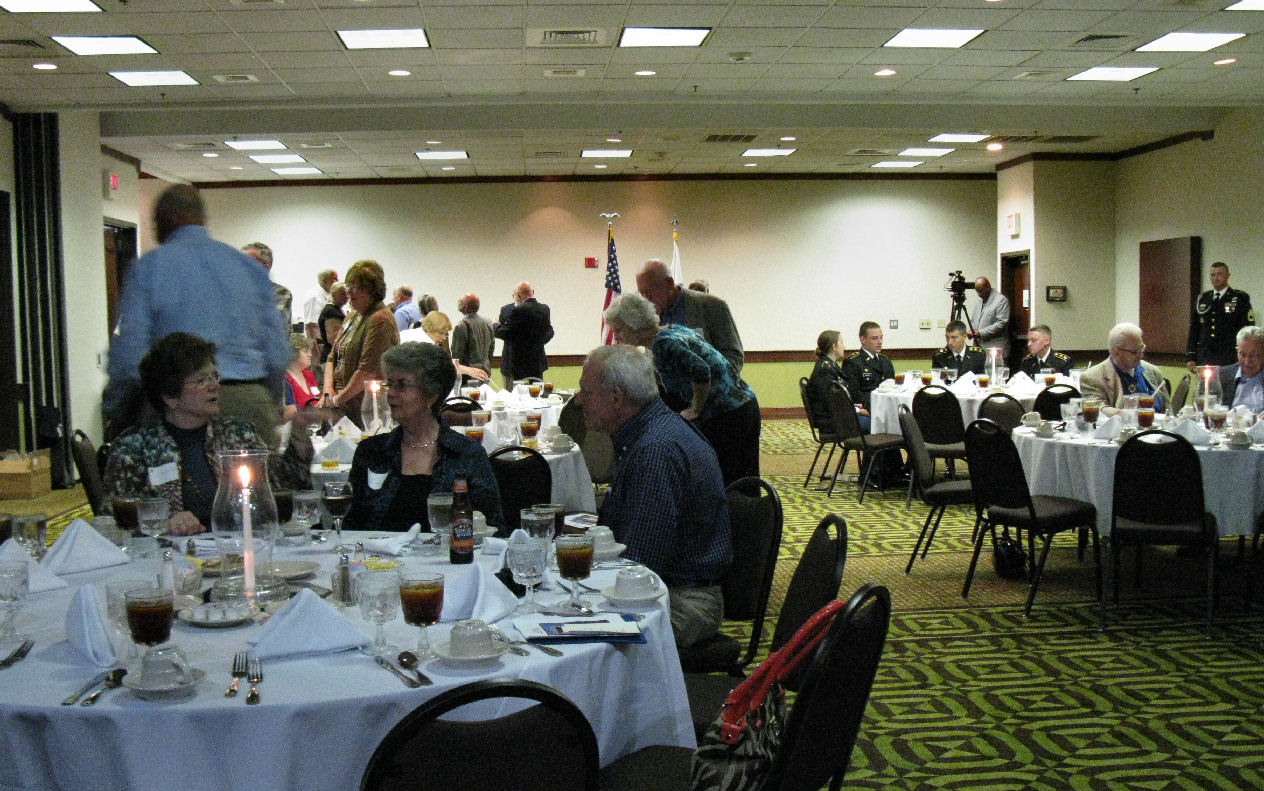
My husband and I met when we were both stationed at Aberdeen Proving Ground, Maryland.  I did not make the military a career, but he did.  This evening, we met with old friends, my husband’s former co-workers, and friends-of-friends at the USAREUR G-2 reunion banquet.

The talk ranged from kids to grandkids, to who we knew in common, to where we’ve traveled and where we ought to travel, to our European adventures, and inevitably to terrorists.

The terrorist angle was underlined by a twenty-minute talk given by Major General (retired) James Dozier who was kidnapped in 1981 by the Italian terrorist group, the Red Brigades, and was held captive for six weeks in a tent erected inside an apartment in Padua, Italy.

The majority of American personnel apparently weren’t terrorist targets as it was high-profile people whom the terrorists seemed to prefer.  Still, while living in Munich, it was unsettling to know that just across the Alps, terrorists had kidnapped an American soldier.  At the time we couldn’t know that General Dozier would be rescued as both the Baader-Meinhof group in Germany and the Red Brigades in Italy had murdered kidnapped victims (Google Jurgen Ponto and Aldo Moro).  That General Dozier is able to give talks such as this was not inevitable — the guard on duty at the time had been given a gun with which to shoot the general in the event of a rescue attempt, but did not use it because he said he couldn’t shoot a sleeping man.  Stockholm Syndrome on the part of kidnappers isn’t always a bad thing.

Finally, thanks go to the author of Secrets of the Cold War, for organizing the reunion.

For Cold War veterans who were assigned to Germany, take a trip down memory lane with Mr. McCaslin’s book.  Thanks for the autograph, Lee.

« Previous Page