Too-long/didn’t-read synopsis: DoD schools have always been political although probably not visible to the students. We were, and are, surrounded by politics.

Kindley Air Force Base high School, later named Roger Chaffee High School in honor of the astronaut killed in a training accident.

Just the presence of schools, stateside or overseas, was politically charged. In Germany, the government (reasonably) didn’t want to keep the American kids in their schools because of the language barrier and the cost. In the ‘50s, the American kids went to local schools to the point of riding the train to school. My American bosswhen I worked in a civilian personnel office, the daughter of an Army officer who’d been assigned to Germany not long after World War II, had Stories about that. My German supervisors had stories about running from the Russians — my local German boss swam a river to get away.

Once American schools were established, DoD had to pony up the cash for building them better than the Quonset huts that served as schoolrooms for many year. There were factions higher up in the Pentagon that didn’t want the expense of having dependents overseas at all — housing, commissaries, rec centers, recreation areas, schools, big hospitals, larger churches, larger libraries with a wider range of books, more cars, and on and on.

Concerning the presence of families, the host nations didn’t want to be “hosting” large numbers of men with nothing much to do other than go out with each other which wasn’t, for the most part, their cup of tea. All those young men caused friction between the overseas servicemembers and local young men. Having families normalized the communities even though lower ranking enlisted people often didn’t like pay and housing differences.. Families were also hostages to fortune. From the US point of view, having families in-country improved the outlook of host nation politicians because why would the US bring their wives and children to Europe (in a ‘50s and ‘60s environment) if the US didn’t intend to keep West Germany safe from the Warsaw Pact?

Then there were the taxes. I don’t know about all the countries hosting US personnel, but West Germany wasn’t particularly happy about losing tax D-Marks to American buyers. I know that in Munich in the early 80s the American housing community tried having yard sales. Some of the local Germans learned of them and showed up. Once the German authorities got wind of that, well, the Zoll/Customs people took it to Command and then for any yard sales, we all had to check for ID cards and refuse to sell to non-ID card holders. Well, that squelched the yard sales. Haggling with buyers in another language was hard enough without having to say, “Do you have an ID card? Sorry …”

Taxes were also the reason for gas coupons, and ration cards for cigarettes, and liquor. My mom pasted into a photo album military “script” (money) that she and my dad used in England. Tupperware parties were controlled. In the early 70s, hostesses would close the curtains during the party and the party-goers had German taxes or postage tacked on to their plastic kitchenware bills because the Tupperware had to come from either local suppliers (taxes), or through the mail to a local street address and not to a military APO address.

Politics surrounded us all the time if we knew what to look for. The NATO Status of Forces Agreement, SOFA, is full of that stuff, although not in specific terms such as “Tupperware.”

Back to schools (the original discussion), even internally within the American community there were politics. Some installation commanders didn’t like that they had no control over the Department of Defense Dependent Schools (DoDDS) curriculum, sports, and hiring. The Department of Defense Education Activity (DoDEA) that controlled DoDDS was separate from the command structure of local installations, but the installations were responsible for the logistical side of things, building maintenance especially. Housing Referral offices supported CONUS-hired teachers; hospitals and clinics had to do civilian insurance paperwork; ID & ration cards had to be issued and controlled; etc. Installation commanders had the school responsibilities but no oversight.

Then, the whole border situation was political. As were Non-combatant Evacuation Operations (NEO) briefings — those lectures in the movie theater for the adults about how family members were to get out of Europe in case of a Warsaw Pact invasion.

For autos, we had the different-from-local-nationals license plates, up until the Baader-Meinhof/Red Brigades terrorism. After that, the plates changed to white with black top & bottom stripes to mimic the West German license plates (as if any bad guys couldn’t see them).

I don’t say all this to influence anyone to bring politics to the group, only to point out that politics surrounded military families whether they were overseas or in the States. Our situation as DoDDS students wasn’t all school dances, riding for hours to football games, and the quality of school lunches.

Re: school lunches, a group of parents and teachers had a meeting with the Army Air Force Exchange Service (AAFES) food supervisor (a neighbor, but I don’t think he recognized me even though our youngest daughters were best friends). The parents and teachers wanted healthier meals and fewer snacks. The AAFES food guy deflected throughout the meeting: sugar wasn’t bad for you. By the end of the meeting, my older daughter’s teacher was actually in tears. To quote my daughter’s twin brother, “Yeah, this one kid went through the high school lunch line and had six doughnuts and a coke for lunch.” (the high schoolers were in another part of the L-shaped lunch room away from the elementary schoolers, but both lunch lines were open).

Then there were the bomb scares. And terrorist attacks on senior officers. And actual bombs in parking lots. We were surrounded by politics whether it was from terrorists, enemy troops, or recalcitrant AAFES officials.

Yes, this discussion list (for which I originally wrote this) can provide a safe-haven from the current whirlwind of changes and turbulence, but just as the changes may permeate our private lives, they’ll probably sneak onto the list. Just like when we were kids, politics and their differences surround us.

aka: “I used to live there!”

Yellowfin tuna at the Aquarium in Bermuda.
On sunny days in the turquoise water, swimmers can see fish darting around.

An exhibit in Germany by the Museum of the American Military Family showcases the stories in the Museum’s book, Host Nation Hospitality. The book is a memoir collection from people affiliated with the US military who enjoyed living as guests in other countries. For myself, these places were England, Bermuda, Germany, and Belgium.

This post is a bit late from the starting time of the exhibit (Life threw me another plot twist), but better late than never. If you’re in Germany near Weil im Schönbuch (in the vicinity of Böblingen), you can visit the exhibit through the end of December. To quote so many advertisements, “make your reservations now!” 

To vicariously share the experiences, if you’re not in Germany so that you can visit the exhibit, the book is available from Amazon. I find it especially intriguing to couple reading the book with exploring Google Maps. That way, I can see the cities and countryside where the adventures took place.

Here’s a toast to armchair travelers exploring the world. Happy travels.

This morning’s travel adventure (which is probably better experienced on a tablet than on a phone) is to Iceland’s Thingvellir National Park which is rather a bleak landscape on the surface, but is the accessible site of two tectonic plates. The direct experience of the plates is in the Silfra fissure where, next to a van in the Icelandic outdoors, visitors can don wetsuits and fins, and then penguin-walk to the entry stairs so they can snorkel between the plates. Bless those staunch visitors and their cameras!

Silfra Fissure entry, Thingvellir National Park, Iceland

When I saw that first Facebook photo of a diver floating in an underwater chasm and touching Europe and North America,” I thought the diver was in the sea. Where the diver and photographer really were might be called a large creek in the Icelandic wilderness — the Silfra fissure — where crystal clear glacial meltwater runs to the sea. Still fascinating, but no ocean is involved.

Once the suit-clad snorkelers are in the water and between the plates, their experience must be like that of birds gliding between mountain peaks — really, really close peaks. Those magic moments are brought to us at home by the equal magic of tech: our gizmos, the Internet, the Go-Pro cameras, Google’s map service and, of course, electricity. The magic is now so everyday, but the parts all combine to form the palantirs of our time.

If you visit the Google map site linked above, you’ll still need to click around to find the videos: clicking Photos and then Videos seems to be reliable, but there are always gremlins. Or click on the map to get to the Google Street View walker. It seems to come up different each time.

The writers for the Museum of American Military Families (MAMF) have produced yet another volume in the series of military memoirs, Host Nation Hospitality. This latest book focuses, in their own words, on the experiences abroad of American military families. We leave the greater sociological examination of a post-WW2 worldwide diaspora of military forces to other writers and instead tell the everyday stories of our lives outside the US, going not always where we would have chosen, but, as always, where our fathers, mothers, or spouses were needed.

In the line of books produced by the Museum, the focus is exclusively on the experiences of people affiliated with the American military, but experiences that don’t often get much airplay. In this book, the memoir stories come from around the world remembered by American military family members and by servicemembers themselves. The stories come from all the continents except Antarctica. They come from writers who were children or young adults during World War Two, through the Cold War and Vietnam, through the drawdown years after the Cold War, through the two decades in east Asia, and on up to writers from the present day. The stories range from the comical, to the poignant, to the disastrous. They are the stories of our lives.

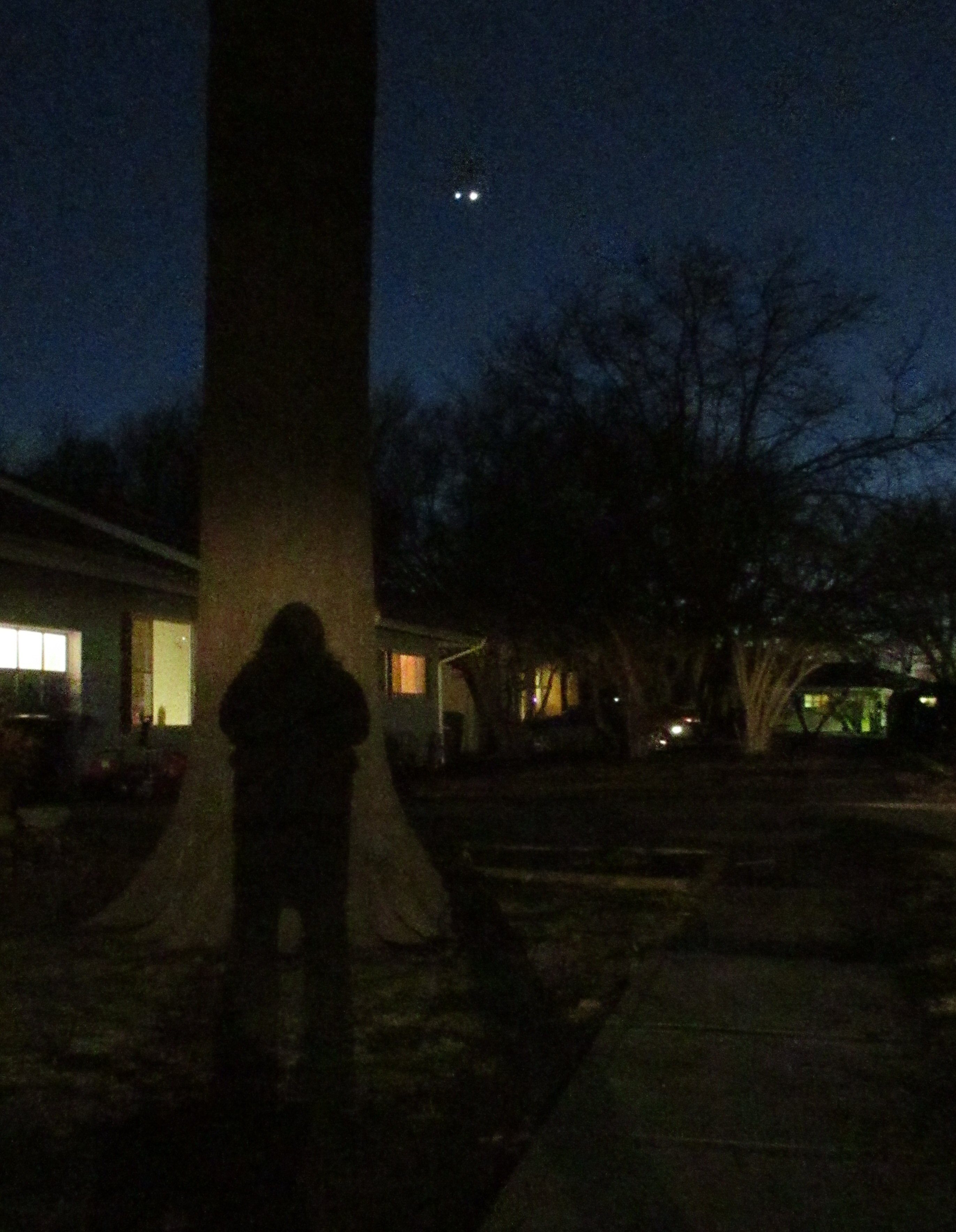
I knew about the then-upcoming conjunction, but “strangely enough” (not), Life got in the way. Luckily, the astral event came to my attention before it was over and I toddled outside with my wee non-astro-camera on a tripod (a Canon Sure Shot). The photos aren’t gee-whiz wonderful, but I caught Jupiter and Venus before they dipped below the western horizon.

Everyone’s favorite Guy In The Sky is still strutting his stuff since the northern hemisphere winter is still clocking along (snow or rain due on Friday), so I also have a shot of the winter constellation, Orion. He’s in the image that looks like a black square. Click the image to give him a hello.

Th-th-th-that’s all folks. Time to go park myself in front of the tube and kick back with a relaxing murder mystery. <insert Loony Tunes sign-off music>

The death of Queen Elizabeth hit me hard. I cried. Not wild, crazy boo-hooing, just a steady feeling of loss. The queen’s death reminded me of my mother’s death ten years ago. Losing the Queen just took me back to my own grief.

Since I was young, I’ve kept up through the decades on happenings concerning the Queen and her family. Despite that awareness, I’m not flying a Union Jack, my Facebook feed isn’t a constant stream of shared royal drama, and I haven’t crocheted a small, wooly Queen as a topper for a post in front of my house. I’m my kind of English — a young child’s version, frozen in time — but only inside my house. Outside, I suppose I’m just a boring-looking bland person, who “isn’t from around here.”

As an American, though, why do I have any concern about the head of state of another country? Is this the same thrill of vicariously living life through beauty and fortune as (I think) happens with celebrities or with Diana Spencer? For me, I don’t think so because my first memories are of England. That’s where I lived as a young child, and not too far from the Queen and her family (along with so many other Londoners). 

The London suburb house that formed my concept of Home.

My dad was stationed with the post-World War II American forces in England, but me being a (most junior) member of an overseas military force wasn’t my experience of my life. For me, the place I lived imprinted itself on me as “home:” rain, birds singing, the smell of roses in our back garden, the shoosh of tires on wet pavement. 

In addition to rain, birds, and tires (or should I type “tyres?”), there was the Queen. Although, People Who Say They Know About These Things tell me I was too young to remember the rain, birds, and tires/tyres, that opinion doesn’t stop me from doing so. The perfume of roses takes me back, every time.

Even though I lived in London during the end of his reign, I remember nothing about King George VI (Queen Elizabeth’s father). The Queen was different. For me, she wasn’t a passing event, but rather a continuing reality. The iconography of the British monarchy — such as the Queen’s Guards in their red coats — helped to cement into my universe the permanence and prominence of The Queen & Fam. Until a couple weeks ago, no matter where, no matter when, Queen Elizabeth reigned.

Me with an English friend on an outing to Windsor Castle.

As a young child I was aware of queens. In the days before Elizabeth II’s coronation, I probably heard the word “queen” repeated on the radio. “Coronation” wouldn’t have stuck in my mind, but “queen” would because I knew about queens from my nursery rhymes. Queens made tarts, had pussycats frighten little mice under their chairs, and sat in parlors eating bread and honey. Queens of some sort were part of my everyday life, unlike, say, presidents, of whom I knew nothing.

Time passed leading up to the coronation and my parents rented a television set to watch the occasion along with millions of others. I was probably in the living room to witness the history, but I don’t think the pomp and ceremony would have held my interest. Our souvenir coronation book, though, that was a different story. That interest lasted forever — I still have the book — and I treated it like one of my favorite picture books. For years, that book told me about The Queen. 

Coronation souvenir book, with faded cover from where the long-gone dust jacket was torn.

Later, when I was in the U.S. as “an American,” you’d think I’d feel at home. Evolution, though, failed to include a setting in my head for “your imprinted home imprinted is a foreign country.” It was the U.S. that seemed foreign. My imprinting told me that home was the place with soft rain, and birds, and roses, and tires/tyres. Home was not a place with violent thunderstorms that turned the sky green while dropping hail that turned the green grass white, and of shocking wintry static electricity. 

First move that I remember very distinctly. The lavatory door — on heavy springs to keep the door shut in heavy seas — slammed on my thumb. I have a memory of what “sick bay” looks like.

Of course, I became used to the new home with its storms, hail, and bright blue skies. You just do. Later, I became used to an island home with pink beaches. By high school, the homes didn’t need to be adapted to as much — they were just going to change.

“Home” was kept in books — photo albums and storybooks — on PBS which I watched with my parents, and, of course, in the souvenir coronation book. Still, once we left “home,” I never again lived there. I always lived somewhere else, and, of course, some-when else.  Even though I carried with me my image of “home,” like everyone else, England moved on through the years. If I’d visited my old house, the England I found there wouldn’t have been the one I left. Still, the Queen went with me (via the news) no matter where I was, so I did keep up with her in real time.

There is a name for my experience of “being from” somewhere other than the home of your parents or your country: “third culture kids.” A lot of explanation is wrapped up in the description, not all of which matches what I feel, but never mind. My job for me isn’t to match someone else’s evaluation of my experience.

And so, all these years later, I find myself as an American in the U.S. mourning a woman whose subject I never was.  In my heart, though, she’s there, with the rain, the birds, the tyres, and the roses. Long remember the Queen.

E Pluribus Unum: GRAICE Under Pressure

For the release of the title, E Pluribus Unum: GRAICE Under Pressure from The Museum of the American Military Family, director Circe Olson Woessner talked about the book with my co-writer-in-residence, Connie Kinsey and me.

(yeah, I keep sharing the cover photo — credit the non-profit ad budget of $0.00 <smiley face> )

Launch day has arrived for E Pluribus Unum: GRAICE Under Pressure, another anthology produced by the Museum of the American Military Family.

E Pluribus Unum: GRAICE Under Pressure joins two other books from the Museum. One, Schooling With Uncle Sam, is a first-person memoir collection of DoD schooling with the overseas American military. The other, On Freedom’s Frontier, gathered first-person recollections of American military service on the tank-defended, and land-mine-infested border between West and East Germany–the Iron Curtain. All three books were shepherded by Circe Olson Woessner, the Museum’s executive director.

To quote from the Museum’s press release,

“The motto, E Pluribus Unum, means ‘out of many, one.’ The museum’s latest project E Pluribus Unum: GRAICE Under Pressure — gives title and substance to a newly-released multi-faceted study exploring if the many do indeed become one,” Dr. Circe Olson Woessner, Executive Director of the Museum of the American Military Family (MAMF) explains. “E Pluribus Unum: GRAICE under Pressure curates, in one volume, stories from hundreds of military-connected individuals based on their service experience seen through the lenses of GRAICE (Gender; Religion; rAce; Identity; Culture; and Ethnicity.).”

In writing E Pluribus Unum, none of us writers knew how the others approached the writing prompts or how they explained the way military life affected their experiences of the GRAICEs. Each of us expanded on our experiences.

My essays are:

  • Supply Train
  • Boxes
  • Tl;dr: One Hundred Years of War
  • Translating Mil-speak to Civilianese
  • The Military: It’s Another World
  • Army of One
  • Gender: Brains, Brawn, or Both?
  • No Atheists in Foxholes v. Keep Your God Out Of My Foxhole
  • Race, in One Person’s Military Experience
  • Who Are Military People?
  • E Pluribus Unum.

A group of similar essays were written by my co-writer-in-residence, Connie Kinsey, a Marine Corps brat. Scattered between the essays are the book’s illustrations, conceived and produced by “the son of a world traveling family,” Brandon Palma who founded 8thDayCreate.

To polish the book, Amy Hines Woody, an anthropologist and an Air Force retiree, wrote the introduction. Anthropological PhD candidates, K.T. Hanson and Chelsea E. Hunter, put under a sociological microscope raw survey data collected online by the Museum from self-selected respondents. They added fifty pages of survey analysis to the over two hundred pages of first-person experiences. The anonymity of the surveys provided the analysts with much candid information.

Despite pride shown by many of the contributors, E Pluribus Unum is not a hoo-rah rubber-stamp of military life. Likewise, the book is not an invective-laden tirade. It is an authentic look by people with something to say about their lives, either in uniform or close to uniformed personnel.

For those with an interest in what takes place behind the installation fence, I hope you enjoy the book.

I’ve been silent here a while, but <she says, brightly> I have an excuse! I contributed to a book.

For the past year and a half I’ve been writing essays for an examination of gender, race, identity, culture, and ethnicity in the military family for a publication by the Museum of the American Military Family. The museum is near Albuquerque, New Mexico, but we writers are scattered across the country.

The book, E Pluribus Unum: GRAICE Under Pressure, is an examination of gender, religion, race, identity, culture, and ethnicity in the military family.

The project, led by Dr. Circe Olson Woessner, founder and director of the Museum, is in the final stages and should be released in July of this year. I’m happy to have been a writer in residence as a part of the project.

E Pluribus Unum: GRAICE Under Pressure

My publisher recently asked what I’d like readers to know about me from my writing. The question was a new slant on my writing’s purpose. I suppose the chief “about me” revelations would be repeated cups of tea, and a succession of cat companions.

Otherwise, anything the reader learns about me from a piece is a byproduct not the focus. The purpose of my essays and stories is either the illumination of the topic, or finding a reader’s connection to it. During brainstorming, one question is what can my writing generate within the reader that gives that reader a tingle.

“I know that.”
“I did that!”
“Omigosh. That’s what I remember, too.”

Of course, such reader identification only happens among those who have shared those types of experiences. For readers who haven’t undergone similar events, my hope is to pique interest.

“Well, that’s another way to look at it.”
“Really? I’ve never even heard anything like that.”
“Who knew?”

There’s always the risk of the “You’re nuts!” reaction, but that’s just the price of going for the big bucks.

Much writing is meant to be informative, educational, or enlightening — all of which are pretty much in the same vein: revealing something to the reader. In this piece, the main revelation is that I write from a need to write. “Chatty Cathy syndrome,” according to my dad. Talking, writing, photographing: they’re all communication.

In school, midway through the last century, my early writing was composed of notes to a junior high friend. They were much like this—short essays. That hasn’t changed. At the time, my writing topics were then-current junior high concerns, usually composed during a teacher’s lecture. My inner voice drowned out anything the teacher had to say. Today, my chatter on Facebook takes the place of my earlier note-passing. Before Facebook, I’d gone through desktop publishing, Yahoo groups discussions, blogging, and a hot second on MySpace. I haven’t branched out to Patreon or Substack because they seem to require a lot of adult focus and dedication. Unfortunately, a part of me is still in junior high. Perhaps, for entertainment value, I should share more cat pictures.

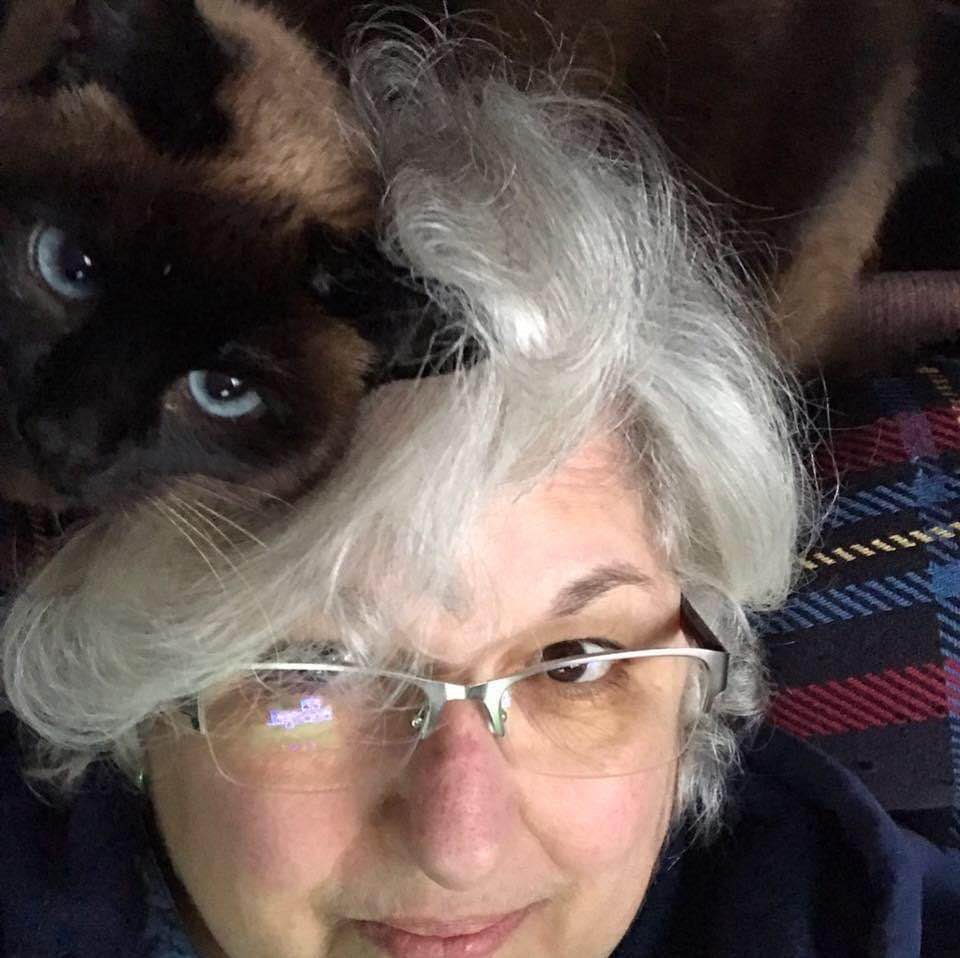
Minka-doo loves me when she’s feeling snackish.