Too-long/didn’t-read synopsis: DoD schools have always been political although probably not visible to the students. We were, and are, surrounded by politics.

Kindley Air Force Base high School, later named Roger Chaffee High School in honor of the astronaut killed in a training accident.

Just the presence of schools, stateside or overseas, was politically charged. In Germany, the government (reasonably) didn’t want to keep the American kids in their schools because of the language barrier and the cost. In the ‘50s, the American kids went to local schools to the point of riding the train to school. My American bosswhen I worked in a civilian personnel office, the daughter of an Army officer who’d been assigned to Germany not long after World War II, had Stories about that. My German supervisors had stories about running from the Russians — my local German boss swam a river to get away.

Once American schools were established, DoD had to pony up the cash for building them better than the Quonset huts that served as schoolrooms for many year. There were factions higher up in the Pentagon that didn’t want the expense of having dependents overseas at all — housing, commissaries, rec centers, recreation areas, schools, big hospitals, larger churches, larger libraries with a wider range of books, more cars, and on and on.

Concerning the presence of families, the host nations didn’t want to be “hosting” large numbers of men with nothing much to do other than go out with each other which wasn’t, for the most part, their cup of tea. All those young men caused friction between the overseas servicemembers and local young men. Having families normalized the communities even though lower ranking enlisted people often didn’t like pay and housing differences.. Families were also hostages to fortune. From the US point of view, having families in-country improved the outlook of host nation politicians because why would the US bring their wives and children to Europe (in a ‘50s and ‘60s environment) if the US didn’t intend to keep West Germany safe from the Warsaw Pact?

Then there were the taxes. I don’t know about all the countries hosting US personnel, but West Germany wasn’t particularly happy about losing tax D-Marks to American buyers. I know that in Munich in the early 80s the American housing community tried having yard sales. Some of the local Germans learned of them and showed up. Once the German authorities got wind of that, well, the Zoll/Customs people took it to Command and then for any yard sales, we all had to check for ID cards and refuse to sell to non-ID card holders. Well, that squelched the yard sales. Haggling with buyers in another language was hard enough without having to say, “Do you have an ID card? Sorry …”

Taxes were also the reason for gas coupons, and ration cards for cigarettes, and liquor. My mom pasted into a photo album military “script” (money) that she and my dad used in England. Tupperware parties were controlled. In the early 70s, hostesses would close the curtains during the party and the party-goers had German taxes or postage tacked on to their plastic kitchenware bills because the Tupperware had to come from either local suppliers (taxes), or through the mail to a local street address and not to a military APO address.

Politics surrounded us all the time if we knew what to look for. The NATO Status of Forces Agreement, SOFA, is full of that stuff, although not in specific terms such as “Tupperware.”

Back to schools (the original discussion), even internally within the American community there were politics. Some installation commanders didn’t like that they had no control over the Department of Defense Dependent Schools (DoDDS) curriculum, sports, and hiring. The Department of Defense Education Activity (DoDEA) that controlled DoDDS was separate from the command structure of local installations, but the installations were responsible for the logistical side of things, building maintenance especially. Housing Referral offices supported CONUS-hired teachers; hospitals and clinics had to do civilian insurance paperwork; ID & ration cards had to be issued and controlled; etc. Installation commanders had the school responsibilities but no oversight.

Then, the whole border situation was political. As were Non-combatant Evacuation Operations (NEO) briefings — those lectures in the movie theater for the adults about how family members were to get out of Europe in case of a Warsaw Pact invasion.

For autos, we had the different-from-local-nationals license plates, up until the Baader-Meinhof/Red Brigades terrorism. After that, the plates changed to white with black top & bottom stripes to mimic the West German license plates (as if any bad guys couldn’t see them).

I don’t say all this to influence anyone to bring politics to the group, only to point out that politics surrounded military families whether they were overseas or in the States. Our situation as DoDDS students wasn’t all school dances, riding for hours to football games, and the quality of school lunches.

Re: school lunches, a group of parents and teachers had a meeting with the Army Air Force Exchange Service (AAFES) food supervisor (a neighbor, but I don’t think he recognized me even though our youngest daughters were best friends). The parents and teachers wanted healthier meals and fewer snacks. The AAFES food guy deflected throughout the meeting: sugar wasn’t bad for you. By the end of the meeting, my older daughter’s teacher was actually in tears. To quote my daughter’s twin brother, “Yeah, this one kid went through the high school lunch line and had six doughnuts and a coke for lunch.” (the high schoolers were in another part of the L-shaped lunch room away from the elementary schoolers, but both lunch lines were open).

Then there were the bomb scares. And terrorist attacks on senior officers. And actual bombs in parking lots. We were surrounded by politics whether it was from terrorists, enemy troops, or recalcitrant AAFES officials.

Yes, this discussion list (for which I originally wrote this) can provide a safe-haven from the current whirlwind of changes and turbulence, but just as the changes may permeate our private lives, they’ll probably sneak onto the list. Just like when we were kids, politics and their differences surround us.

aka: “I used to live there!”

Yellowfin tuna at the Aquarium in Bermuda.
On sunny days in the turquoise water, swimmers can see fish darting around.

An exhibit in Germany by the Museum of the American Military Family showcases the stories in the Museum’s book, Host Nation Hospitality. The book is a memoir collection from people affiliated with the US military who enjoyed living as guests in other countries. For myself, these places were England, Bermuda, Germany, and Belgium.

This post is a bit late from the starting time of the exhibit (Life threw me another plot twist), but better late than never. If you’re in Germany near Weil im Schönbuch (in the vicinity of Böblingen), you can visit the exhibit through the end of December. To quote so many advertisements, “make your reservations now!” 

To vicariously share the experiences, if you’re not in Germany so that you can visit the exhibit, the book is available from Amazon. I find it especially intriguing to couple reading the book with exploring Google Maps. That way, I can see the cities and countryside where the adventures took place.

Here’s a toast to armchair travelers exploring the world. Happy travels.

The Veterans Writing Project picked up my story “Beer Here” for their publication, O-Dark-Thirty.

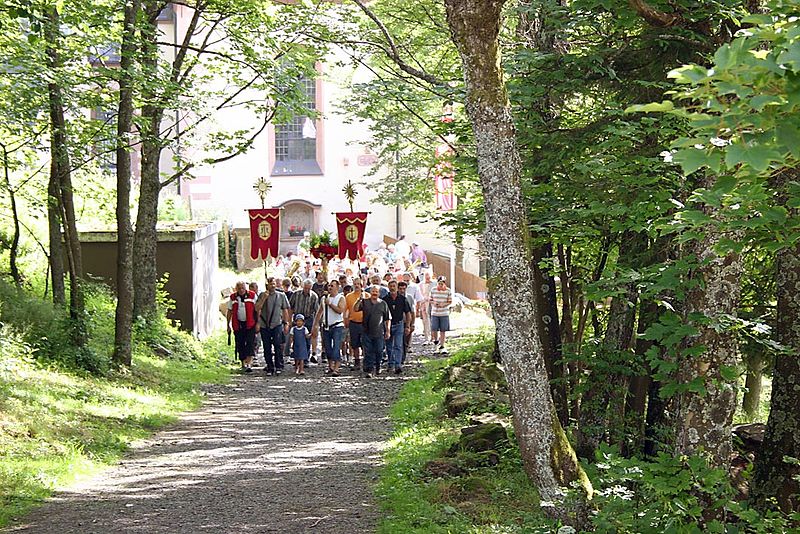
Procession from the Kreuzberg monastery up to the crosses on the mountain.   Picture courtesy of Wikpedia.

Procession from the Kreuzberg monastery up to the crosses on the mountain. Picture courtesy of Wikpedia.

Beer Here

Barb Hoskins, a Cold War-era CI investigator runs into a platoon-mate from Basic who is on her way back to the Land of the Round Doorknob. They go out for a last-minute fling at a monastery, famed for its beer, and wind up with more action than they bargained for.

The story is one of a series that will be part of a book, Culture Shock.

During this holiday season, I’m missing the at-home sights and sounds of not only an American Christmas, but also those of my other-cultures, traditions given to me through my nomadic military travels (in countries with Christian traditions).

In watching my grandkids, I think it must be nice to be grounded in one’s life, to know who and what you are and not to miss parts of your own life with a sharper pang than that generated by ordinary nostalgia. I don’t know if a settled life is ‘better’ and a nomadic life ‘worse’ (or vice versa) but being from one place might have less existential angst.  Or maybe not.  Hard to tell from the vantage point of having had just the one childhood.

~~~~~~~~~~

I’m in luck concerning my first culture, English, the one I think of in my child’s mind as ‘the way it’s s’posed to be.’  At a young age, you don’t know you’re not living where you’re nationally-assigned to be living.  You also don’t know that what you’re experiencing as ‘normal’ is a mix of two cultures, that of your parents, and that of the country in which you live. All you know is that you’re home, and that’s that.

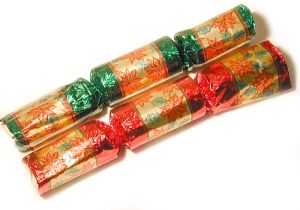
I’m lucky that crackers, as one element of my early Christmases in England, are now readily available.


23 christmas crackers

 ~~~~~~~~~~

Another part of my other-culture heritage is seeing the Gombey dancers from Bermuda.  When I was a kid, the dancers didn’t seem to be as well-organized or to have as good P.R., as they do today, but again, that observation may be a result of the childish attention span.  Still, they’re something I remember seeing on the island around Christmas.  I think we could do with some Gombey dancing around here.

23 Gombey men

 ~~~~~~~~~~

From the decades I spent with my husband in Europe comes the memory of Christmas markets.  Everywhere we went during December we found Christmas markets.  Some were big and some were small, but they all contributed to the seasonal spirit. One of the items commonly found at the markets are figurines for the household Nativity scenes.  The items are expensive and collections are often added to one piece at a time over the years.

A French-culture specialty are santons.  Where Americans limit their Nativity scenes to manger-scenes, the people of Provence have the tradition of making an entire village to host the Nativity.  One display we saw in the city hall of Strasbourg, France filled the entire lobby and the scene was a multi-room panorama as visitors moved through the ‘town.’  Butchers, bakers, candlestick-makers, old men playing boules (like bocce), mothers in houses bathing their infants, beasts and birds and houses and scenery.  C’est magnifique!

The last Christmas we spent in Europe, we visited the Marché de Noel in Mons, Belgium.  The marché (market) was small with little huts selling thick waffles, utterly scrumptious frites (fries should be called Belgian fries rather than French fries),  hot drinks, and little gifts. The main hut displayed a Nativity scene. In the Mons market, the chief attraction was an ice-skating rink.

If we made a video recording of our visit, I haven’t the slightest clue how to get it off our last-century video tape and make a computer file of it, but I’m in luck — other people have recorded their visits and uploaded them to YouTube.  This video ends with a left-handed caress for good luck of the little brass monkey outside the city hall of Mons.

 ~~~~~~~~~~

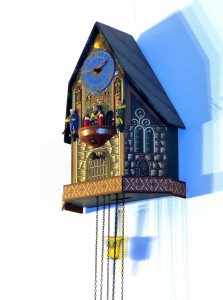
The biggest, and to me the best Christmas market is the Christkindelsmarkt in Nürnberg, Germany, a market that takes place under the gaze of the Frauenkirche (Church of Our Lady), a city symbol memorialized in a clock that I sent to my parents from Germany, many years ago.  With coddling, our clock still ticks away and plays its tune.


12 23 01 Clock

In Nürnberg, the Christmas market spectacle is magnificent as the church rises above the ‘streets’ formed in the market square by row upon row of red and white striped tents. In the tents, innumerable glass ornaments on the counters and hanging from the ceilings in the tents sparkle under the spotlights.  The visual feast is accentuated by the aroma of the small bratwurst (never called “brats”) grilling in the open-air, little sausages that tease the nose and make the mouth water. Mingling with the smell of grilled wurst is the wafting scent of Glühwein (mulled wine) for the grownups and Kinderpunsch (mulled punch) for the kids.  The Christkindlesmarkt is a sensory delight.


With your feet frozen from hours of wandering on the cold cobblestones, it is an absolute treat to find a Konditorei (a German café specializing in coffee and cake) and sit at a linen-draped table sipping hot chocolate and nibbling a slice of Schwarzwälder Kirschtorte (Black Forest cherry cake) with your boxed gingerbread house at your feet.  The event is a lasting memory.

 ~~~~~~~~~~

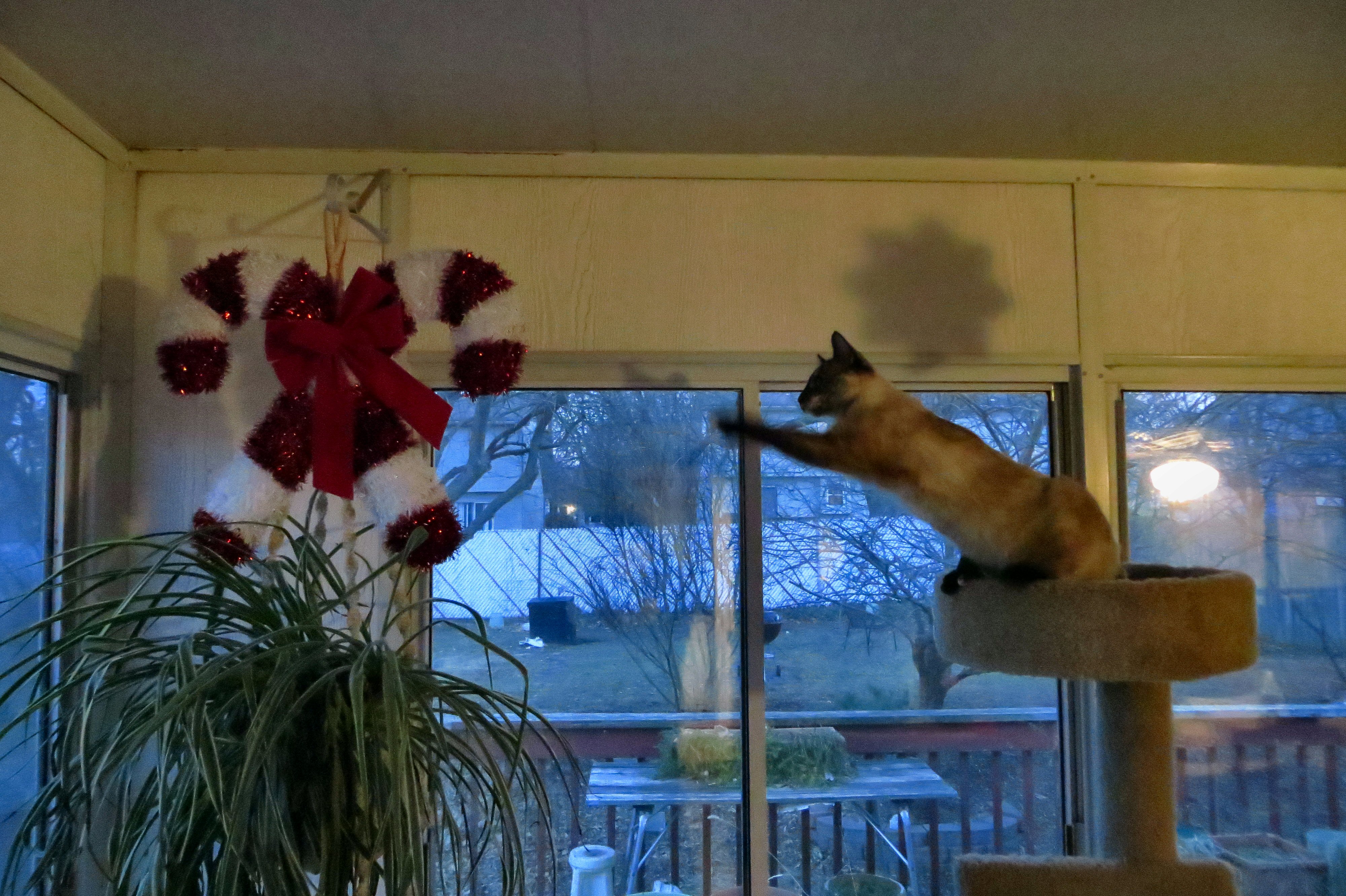
I suppose I wouldn’t be missing all the kinds of Christmases I’ve known if I were in a festively-decorated house, watching the twinkling of the lights on my Christmas tree.  But no, I have cats, specifically, two young cats whose mission is to investigate anything and everything in the house. I’m waiting for them to grow up some more before introducing them to a Christmas tree.  Until then, I have my memories and the entertainment of watching the cats chase through packing paper from catalog orders and jump in and out of empty shipping boxes.

01 Audrey after candycanes

Happy Holidays!

1965: Planes in the backyard U.S. Air Force plane over St. George's Harbour, Bermuda, taken from our backyard on Kindley Air Force Base.

1965: Planes in the backyard
U.S. Air Force plane over St. George’s Harbour, Bermuda, taken from our backyard on Kindley Air Force Base. This plane is the same type as one involved in a crash I heard.

Regardless of the era, military service can be a dangerous line of work. Many military jobs involve either work with dangerous materials or vehicles, or living in an area in which one’s country’s efforts are not appreciated, and it has been this way during the decades following World War II. On one hand there is the point that many of the military actions seem to be imperialistic in nature — “Americanization” — and that we shouldn’t do that. We should stay home, tend to our own knitting.

The flip side to that, from an American viewpoint, is that some country, somewhere, is going to be the ‘leader,’ or perhaps a less domineering view would be the ‘trend setter.’ In any case, one country, or a treaty-bound group, will be the dominant nation. Which country is best suited for that role? Since the top slot will always be ‘there,’ If you don’t want the U.S. to be spending the money, the time, and the people to support the U.S.’s position, which other country do you see as best filling that niche?

Even without a ‘hot’ war in progress, staying alert or supporting other missions have their own dangers, and given the role assumed by the United States of being one of the top dogs in the field of (usually) supporting the downtrodden in many places around the globe, and in the wake of seeing continued deployments to Afghanistan, I was reminded by an article in the Bermuda Sun newspaper of the dangers faced by service members during the Cold War as the newspaper covered the 50th anniversary of an air crash near the island.

Bermuda air disaster, 50 years on, The Bermuda Sun

I well-remember this tragedy because I heard it. I was walking home, probably from the beach on Kindley Air Force Base in Bermuda, and an uncharacteristic boom sounded, as if someone had shot off Anzio Annie, one of the Krupp K5 railway guns used in WWII by the Nazis.

Everyone who lived on Kindley was accustomed to hearing planes as the base was built parallel to the joint military-civilian runway serving Bermuda. We heard everything from Pan Am jetliners, to B-47s, to C-130 Hercules cargo planes, to fighter jets, as well as aircraft whose names I don’t know, and whose job was probably secret. We heard all manner of machines with either propellers or jets, and the runway was so close to everything else, that people could walk along a sidewalk and find themselves behind fighter jets being hit by exhaust. In school, our teachers would pause during lessons when the scream of jet fighters could be heard as the planes hurtled down the runway. Our teachers would wait to continue the lesson until they could once again be heard. Planes were as common, or perhaps more common, than birds.

1965: Kindley AFB, Bermuda Seeing off friends at the MATS terminal, the place where many of us arrived and departed.  In this picture, we're all being blasted by propwash from a Coast Guard plane on which our friend was leaving.

1965: Kindley AFB, Bermuda
Seeing off friends at the MATS terminal, the place where many of us arrived and departed. In this picture, we’re all being blasted by propwash from a Coast Guard plane on which our friend was leaving.

For me, hearing the crash of the two planes, one of which was the same type as the one pictured at the top of this piece, was a reminder of another crash two years before.

U.S. Air Force KC-135 Stratotanker crashes near Spokane, killing 44 airmen, HistoryLink.org

I didn’t live near Spokane, where the crash happened on Mount Kit Carson, but rather at Ellsworth Air Force Base in South Dakota, the place where the flight originated. The fathers of the families of the neighbors directly behind our house and directly in front of our house were both on the plane. The son of the plane’s captain was in my class. Of all the 44 men on the plane, only something like 3 or 4 were single, not that this was any different for their parents and siblings, but only that one or two fewer people on the base were devastated by the tragedy.

The crash at Ellsworth was the first one I remember. It came on the television with no warning and the families had not yet been told. It obviously wasn’t the last one I remember, given the crash in Bermuda, as well as other crashes during our time there. My time with my career-Army husband has contributed more tragedies, such as the Ramstein Air Base airshow Flugtag ’88 disaster that is recent enough to have footage on YouTube, the horrific Lockerbie terrorist attack on Pan Am flight 103, as well as multiple terrorist bombings in the 1970s and 1980s in West Germany.

The effect of the United States military services is far too complex, for better or worse, to be even glossed over in a blog post. All one can do is mention them. The subject is far too complex probably for entire books to sort out. Despite the bad, there is still good, and I hope the people now wearing military service uniforms, and especially the people who continue to be deployed to Afghanistan, are as protected as they can be, that they make the best decisions possible, and even with the odds against this happening, that they all return safely home.

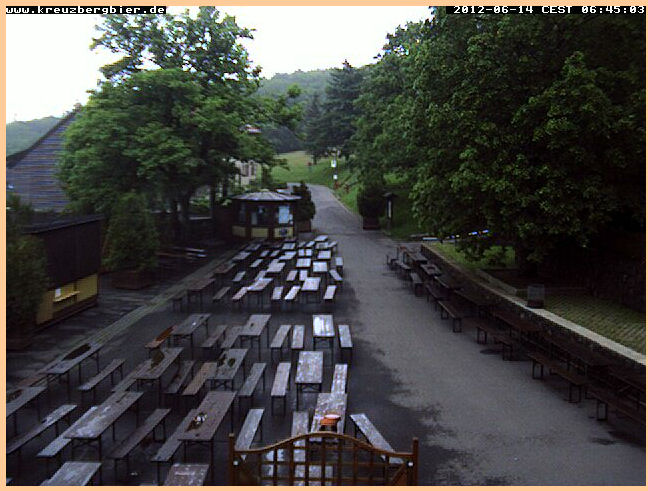
On the Sisters in Crime Guppy email list (Guppy standing for the “Great UnPublished”) the weekly topic question was where you’d choose to be writing.  My reply was that I’d like to be in the Rhön area of the German states of  Hesse, Thuringia and Bavaria doing story research.  The cost to do this being what it is, I’m making do with bratwurst, Google maps and a webcam.

Kreuzberg monastery beer garden at quarter to seven in the morning.