Non-fiction day


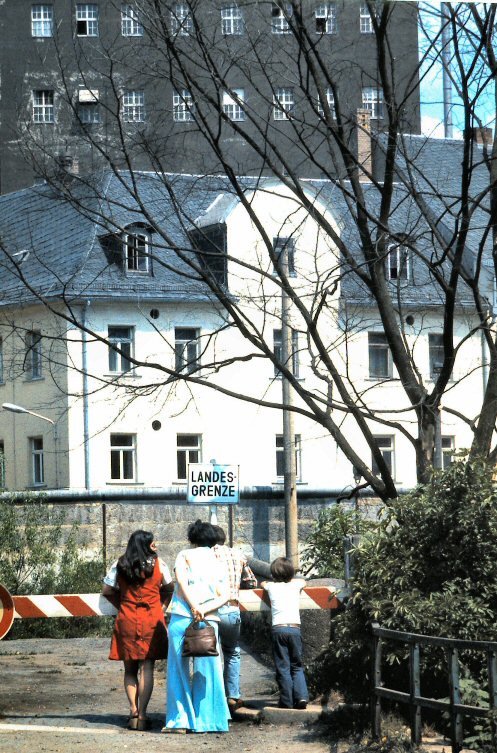
1978: Me, in the red dress, and my son, on the right, with friends, looking across the Saale river into East Germany, near the Bavarian town of Hof.

1978: Me, in the red dress, and my son, on the right, with friends, looking across the Saale river into East Germany, near the Bavarian town of Hof.

German filmmakers are making films depicting life during the 40-year existence of the Deutsche Demokratische Republik, the DDR, East Germany.  Apparently, it’s a space that has been left vacant for the most part.  To quote an NPR review of a recent film, Barbara, a German entry for the Oscars,

“The West kind of got there and said, ‘Now you can be happy.’ … I mean it’s 40 years of their lives. … They can’t be in vain. And no one asked.”

I’ve seen two films about life in the former East Germany after it was “former,” when the life was the life after the fall of the totalitarian Communist regimes in Eastern Europe:  Schulze Gets the Blues and Goodbye Lenin.

Barbara is the first film I’ve watched from the Eastern point of view about how people managed during those 40 years on the other side of the fence.  At the time, no one on this side of the fence imagined they’d ever be a former enemy.

This Friday is my youngest grandson’s sixth birthday. It will be his best birthday yet, at least according to him, because it will be 13 December! Of course, all his other birthdays have been on the 13th of December, but at the end of this week, it will REALLY BE 13 DECEMBER!

He’s jazzed about Friday as only a six-year-old can be about his birthday.

For his present I’ve bought a few toys, of course. No child’s birthday is complete without toys. The present he probably won’t be expecting is a story, a birthday-adventure story about himself featuring his favorite color (blue), his favorite outdoor game (disc golf), with the story set in his favorite place (Wuhu Island from the Wii Sports Resort game).

In addition to all that, the illustrations are by his 10-year old cousin. I printed out a draft of the story that she read, and then she drew six pictures from the story in one of her sketch books.

2013 12 Dec 08 Drawing for Ems's book 01

In this part of the story, my grandson is working at the Swordplay Colosseum on Wuhu Island. The swordplay game is one of his favorites.

In order to get my granddaughter’s pictures to me, and because our schedules are busy, her mom left the sketch book outside their front door in a Ziploc® bag, and her Poppa swung by to pick it up. I scanned the pictures and saved them to my hard drive so that I can print the pages on photo paper. I’ll mount them back-to-back with spray glue to make strong pages, and then bind them into a book with comb-binding, just like my dad used to do for our family photo albums. It will be a production, but I think the little guy will be pleased with the book.

My grandson reads, but he doesn’t read his grandmama’s blog, so this will still be a surprise, as his birthday is in the story.  Just know that on Friday his cousins and I will be wishing him a very happy birthday.


~~~~~~~~~~~~~~~~~~~~~

Update

My grandson is thrilled with the story — he can’t believe how many people he knows in the story.

One of my pet peeves is stories, whether written or performed, that have incorrect military information.  Some of the wrong information is simple, such as my current peeve, and some of it is illogical made-up-stuff.

Tonight’s irritation is with an episode of “Unforgettable.”  In the story, a Veterans Administration doctor has been asked by Unforgettable’s main character about a veteran who is a person of interest in a murder (the Crazed Veteran is always a popular character if you need a military person in your story).   The veteran in question would be fluent in Pashto, a language in Afghanistan.  The doctor replied to the detective that it would take several tours in Afghanistan for a soldier to become fluent in Pashto, and then says that she does have a client in counseling who fits the description — a corporal.

Insert rant about ‘if you plan on writing about something, learn the basic information about it.’

In the Army, a corporal is an E4, a junior enlisted rank.  If this person were a corporal he wouldn’t have had enough time in service to easily become fluent in Pashto, unless he’d been demoted multiple times.  Pashto is a language that the Foreign Service Institute rates as a level 2 or 3 language, levels that take between 34 – 48 weeks of full-time study for basic proficiency. Unless a person were being trained as a linguist, it is unlikely that the Army would invest the time for the training.

Which brings us to another point.  The photo of the uniformed ‘person of interest’ shows a relatively long-haired white-bread man (for today’s military) in an Army uniform, wearing infantry brass backed by a light blue disc.  An infantryman in Afghanistan is not surprising, however, an infantryman wouldn’t have linguistic training.  If an infantryman had acquired fluency in Pashto — either from multiple tours in Afghanistan or from language training — he would have been in the Army long enough to be more than a corporal.  Still, for story-purposes, a Pashto-spouting bad guy is more menacing than your average veteran.

Then there’s the fiction that he’s a corporal.  In today’s Army, very few military occupational specialties (MOSes — ie, ‘jobs’) use the rank of corporal.  An E4 in the infantry would be a specialist unless he were filling a leadership position.

Specialist is a designation retained from when the Army had ranks from Specialist Fourth Class up to Specialist Seventh Class alongside the NCO ranks of the same pay grades.  In today’s Army, and of the specialist ranks, only the E4-Specialist rank remains.  I’d say this story character wouldn’t be a corporal because, as I said before, if he’d been in the Army long enough to be fluent in Pashto, he was probably demoted more than once and wouldn’t be leader material.

Now if this service member were a Marine, then the corporal rank is appropriate — although, as a Pashto-speaking-E4, he still would be suffering from the time-in-service problem concerning the language fluency.

The holes in this one story point are large enough to drive a truck through.

Writers — and producers and directors — if you’re going to use the Crazed Veteran character in your stories, at least do the poor guy the honor of getting his backstory straight.

When you’ve collected lots of books, it helps to have a system for organizing them — if you can’t find what you’re looking for, what’s the use of having it? I often sincerely wonder how people who live in very large houses find things — who keeps track of all the *stuff* that goes into furnishing large spaces?

In organizing my books I chose not to reinvent the wheel.  Someone had already done the groundwork of sorting-subjects, so why not use an existing system?  As for which system, I chose the one most familiar to me, the Dewey Decimal system.  I’ve read that it isn’t as detailed as the Library of Congress system, but as I’m unfamiliar with that system (no college for you, little girl!), I stuck with what I know.

The entire house isn’t rigorously organized as a library — I like to know where things are, but I’m not a rigid purist by any means.  Still, I have them all sorted: mysteries are in the bedroom, writing books are in the writing room, nonfiction is in the three large bookshelves in the basement, general fiction is in the entryway, children’s fiction is in the spare bedroom, cookbooks are near the kitchen, religious studies are under the knickknacks (no connection intended, it’s just where there was room), cartoon books are in the bathroom, and the Agatha Christie collection has a place of honor alongside the Junior Deluxe Editions children’s classics my parents collected when I was a kid.

Thanks to Mr. Dewey, I have a general idea of where to shelve books, but every once in a while a book stumps me.  Years ago a friend gave me a Dewey Decimal Classification book, but working through it to figure out where a book belongs when the classification isn’t obvious can take some time because, in a microwave/Internet/text messaging world, divining library classification entrails is something to be undertaken on a grey, slushy winter day with a cup of cocoa, and that isn’t today.

The book that flummoxed me this morning was CID: Army Detectives in Peace and War.  The press that published it didn’t add the classification numbers I usually rely on (thank you, modern publishers!).  This led to an Internet search — long story short, good old OPAC has it listed at the Ft. Leonard Wood library.  I haven’t regularly used OPAC since we lived in Belgium, so that was a fun trip down memory lane.  I now have the book classified at 355.1, which will put it at the far left end of the shelf of writing books with their 800s numbers.

Sorting books may not be everyone’s cup of cocoa, but if you want to find what you’ve squirreled away, having the books organized is the way to go.

It also gives the kids something benign to share as their penance for having been born into this family.

Three weeks ago we adopted a rescued family of cats — cats we never expected to share a home with. We’d recently lost Dinah, our 19-year old blue point Siamese and we didn’t think we’d want to ‘replace’ her. Dinah was special. We reckoned without our veterinarian daughter who, apparently, is our enabler.

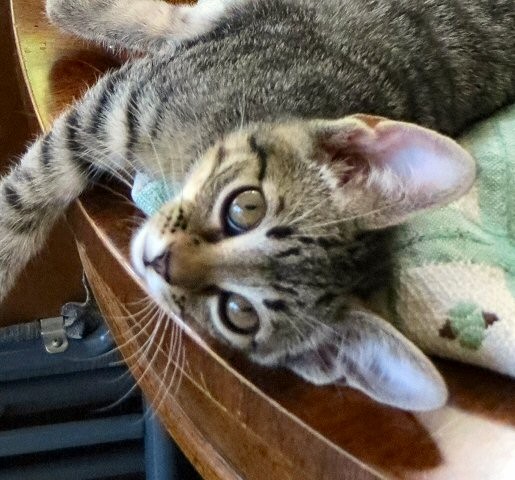
Mama-cat is a seal point Siamese, and the two kittens who came with her are a tortie point polydactyl (6-toed) Siamese and a brown tabby who looks as if he wanted to be an Egyptian Mau. We are charmed by all of them.

As is usual with new members of the household, we needed to be able to call them something. “Hey, you! Get off that!” is unwieldy and too nonspecific, plus it isn’t something a kitten ever responds to. The names I suggested for the two cats we initially intended to adopt were Polly and Ernestine. Polly sounded perfect for the tiny polydactyl girl kitten, and Ernestine would have been just too cute for her mama as Ernest Hemingway had a thing for polydactyls. I was voted down by the local Philistines.

The next round of names were Cocoa and Yum Yum for mother and daughter. When I’m feeling fragile I like to read or listen to gentle stories such as those by Lilian Jackson Braun who named her two main character cats Koko and Yum Yum. Braun was inspired, I assume, by characters from The Mikado, my favorite Gilbert & Sullivan operetta. Koko was a male character in the operetta so Cocoa seemed appropriate for a pretty girl with dark brown Siamese points.

Then they came home. Not only did they come home, but one of the little boy kittens came with them as all the kittens had so much fun with each other it seemed cruel to separate them.

Once the cats were home, we saw that Cocoa didn’t fit the shy mama cat (who has yet to really come out from under the bed) — the repeated k-sounds in the name were too hard. Yum Yum was fine for the little girl but without the Cocoa/Koko companion name, it felt incomplete. Since my ideas for names weren’t working, I let nature take its course with the rest of the family, and they filled in the gap. We now have three named cats: Minka (courtesy of our daughter, who Googled German cat names), and Audrey and Rusty (courtesy of our son who likes the National Lampoon vacation movies).

Minka

Minka

Audrey

Audrey

Rusty

Rusty

Here’s where it gets odd. Yesterday I opened a Word file from 2009 in order to edit the second short story in a series for a main character I’ve been developing. The storyline is irrelevant, but with character names that made me think I ought to be hearing Twilight Zone music. I don’t have a Rusty in the story, but I do have an Audrey and a Minky.

— One name in common is a reasonable coincidence, but two names are decidedly odd.

— Two names that I thought up is a reasonable coincidence, but two names from two people who haven’t Clue 1 about the story, or that I’d even written it, is again, decidedly odd.

I had thought to remove the cat from the story (an unfortunate victim, but from carelessness, not anything horrid) but with the coincidence of the names, it has to stay in. I want to think that what I write comes only from my own imagination but the Audrey and Minky/Minka coincidence makes me feel that maybe I have a muse laughing at me from a corner of the room.
What a week we’ve had. On Monday, the weather was ‘nicely spring,’ meaning that we had no roaring March-style winds, no flood-inducing downpours, and no tornadoes. The end of April was its normal self, almost-brisk at night and teasingly warm in the daytime sun with tickles of breezy coolness when the wind got up to its tricks.

03 daffs by oak

In the middle of the past week, we had a preview of summer. The weather, plus humidity, rose enough so that we could comfortably test the air conditioner. Unfortunately for our pocketbook, all the test seemed to do was burn up about ten hours worth of electricity — the house’s cooling system is in need of a checkup. Still, thanks to the summery warmth, my husband managed to complete some chores that had been bugging him. He was also able to keep the neighbor’s pup company for part of the morning.

06 lonesome dog and the gardener

As is common at this time of the year, the temperatures go up and down. Thursday started out briskly chilly, but we’d been warned that our international neighbor to the north was evicting some of its cold air and that we (among others) would be the recipients of the Canadian weather largesse. Rain soon moved in and gave this early May Thursday the look of a month before — chilly, damp and rain slicked.

08 cold and wet

That evening we had to make a quick trip to a pet store for a new bed for our elderly Siamese family member and during the drive the view from inside the car was one that begged for snowplows. It was nasty enough that I needed my hooded winter coat.

I swear it looked like a blizzard outside.

07 daffodils

(the plants are daffodils, in case you can’t recognize them)

As we drove, the wipers cleared a path leaving a border of snow-arches around the edges of the windshield. Oncoming headlights glowed above their illuminated paths on the wet pavement, while red and green traffic lights gave a Christmassy look to the roads. The incongruous part of the snowy Christmas scene was the underlying Easter landscape: tufts of not-yet-mowed grass beneath leafy oaks and maples interspersed with flowering redbuds and magnolias. It was as if the Imps of Spring from my childhood Rupert books had a miscreant in their midst again.

06 evening

Of course, I’ve seen comments about how we could use some global warming right about now. Believe it or not, that’s what we’ve got. The wacky weather is a byproduct of climate change. You’ve seen the admonition to ‘be the change’? Well, that’s what this weather is. Climate systems are changing and wacky weather is a part of that shift. Unfortunately (for me), I haven’t a clue what to hope for.

If I didn’t like Richard Griffiths for his wonderfully-horrible depiction of Harry Potter’s Uncle Vernon, he’d be at the top of my list of admired people for breaking the fourth wall when a theatre-goer’s cell phone ring interrupted a performance.  Bravo, Mr. Griffiths.

Unfortunately, he won’t be doing that any longer.  I may just sit down for a Harry-fest in his memory.

In Praise of Richard Griffiths, 1947 – 2013

When a 2005 West End production he was starring in was interrupted by a ringtone, he halted the show and addressed the culprit from the stage: “Could the person whose mobile phone it is please leave? The 750 people here would be fully justified in suing you for ruining their afternoon.”

While wandering around my email lists, I came across a discussion that sparked my imagination.  The question was, “One of your favorite characters from a mystery is fixing dinner for you.  Who is the character and what are they making?”

I read the question as “One of your characters …” and I immediately jumped to the one character of mine that I was sure would be able to cook — Lisette, a young German woman who lives with her widowed father and who has a sensible head on her shoulders.

Lisette Lenz  is a clerk in the Army civilian personnel office on (the fictional) Ganzer Barracks near the (equally fictional) town of Zwischenkuppeln, Germany. Lisette is putting together a lovely picnic supper to have after a hike in the hilly Rhön area of northern Bavaria and southern Hesse.

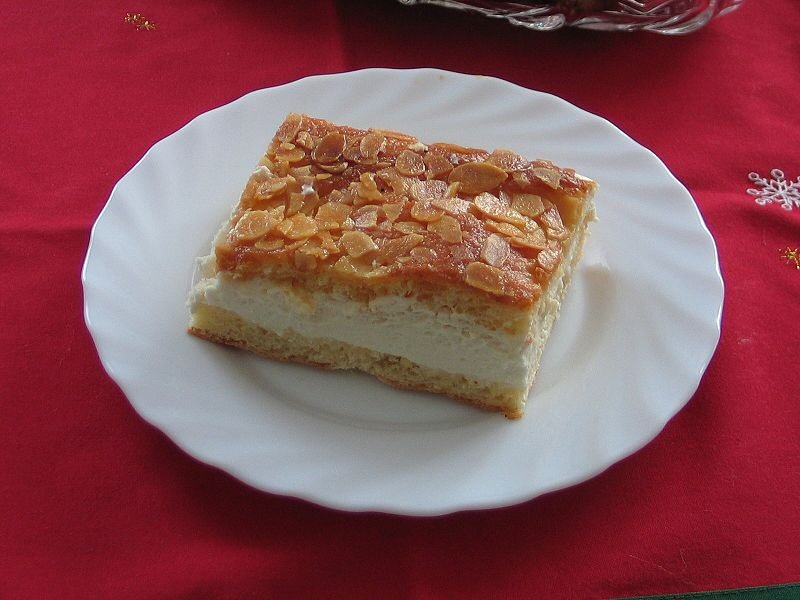
Lisette bought Aufschnitt (various kinds of lunchmeat), Mischbrot (brown German bread), Tilsiter, Emmenthaler and Muenster cheeses, and cultured cream butter for the sandwiches, as well as grapes and some little Cox Orange Pippen apples. Dessert is Bienenstich, a sturdy vanilla pudding-filled cake topped with almonds and honey. For drinking, she has some Gerolsteiner Sprudelwasser (fizzy mineral water) and a bottle of Riesling wine.

When I double-checked the question, I saw that it really asked for “one of your favorite characters from a mystery …”  Insert a deep sigh, here.  After imagining the supper I would have after the hike, nothing else sounded appetizing.  To make things worse, now I want a slice of Bienenstich (and that’s pronounced BEE-nen-stish).

As misery loves company, I will give you a glimpse of the cake, and provide a link to a recipe you can try.

11 bienenstich

(image courtesy of Wikipedia)

Mahlzeit!  (the German version of bon appetit!)

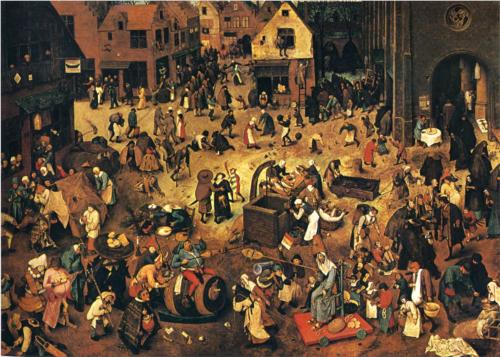
Yesterday in Germany was Rosenmontag. Today, elsewhere in the areas of old-e world-e Christianity, is Pancake Day, aka Shrove Tuesday.  It’s your last chance to use up all that forbidden fat-for-cooking before Lent.

2013 02 Feb 11 Bruegel fight-between-carnival-and-lent-1559.jpg!Blog

Helau!

(pronounced, more or less, to ears tuned to English, as “hello”)

Helau! is the salute heard throughout Rosenmontag parades in the Catholic areas of Germany on the Monday before the beginning of Lent on Ash Wednesday. That would be today. In the U.S., Rosenmontag’s counterpart is Mardi Gras, but Mardi Gras doesn’t have the reputation of the weeks of parties beforehand organized by the Fasching prince and princess, the planning for which begins on the 11th of November – the 11th minute of the 11th day of the 11th month, to be precise.  Fasching’s ‘crazy season’ antics have the same caveat as crazy behavior in Las Vegas,

Rosenmontag is not an official holiday, but is celebrated as if it were. Schools are closed, companies give employees the day off, and the parades are shown on television. A big difference between American celebrations and those in Germany is that the celebrating happens in towns large and small and isn’t centralized. Instead of watching Beyonce and her crew, or the current pop gods and goddesses, townspeople watch local talent. Everybody joins in.

Like Mardi Gras, Rosenmontag is a reason to party. From Christmas/Solstice through New Year, the various incarnations of Groundhog day, the Lunar (Chinese) New Year and on through to St. Patrick’s day, enthusiasm for winter parties is high. Fasching and Rosenmontag may have stemmed from the gloom of northern hemisphere winters and the need to find something to do when working in the fields wasn’t easy, or useful.

Non-Catholic Americans may have already substituted Superbowl parties for winter religious celebrations from centuries past. Tuning out crappy weather by having a party, before cabin fever threatens the happiest of couples, seems to be common enough to almost be a subject worth scientific scrutiny – and wouldn’t a mad scientist make an unusual Fasching party costume.

If you’ve ever daydreamed about visiting Germany, a trip during Fasching — the “fifth season” — is off-season for travel, and hotels won’t be as crowded as during the summer months, or during that big party in one city in early October.

What happens on Rosenmontag, stays on Rosenmontag so you’re allowed to get crazy. And if you can’t afford to travel, click and enjoy.

« Previous PageNext Page »