I’ve been busy elsewhere with fallout from Learning by Grace, Inc., et al, v. Idoni, an artifact from my other life, so I haven’t been blogging about stories, writing, or the audio books I’ve been entertaining myself with, the most recent being Anteater of Death (a cozy mystery set in a zoo) and Foul Matter (a wicked take on the publishing industry by Martha Grimes, with the best hit-men evah!)

A link this morning from one of the writers at SheWrites, though, gave me the opportunity to do a quick link to a piece whose subject is one I’ve thought about:  ‘staying in touch online,’ in contrast with the memory of long days of relative solitude, ie, Before the Internet (BI).

  • Jonathan Fields:  “Creative Kryptonite and the Death of Productivity”
    Hyperconnectivity requires a massive volume of switchtasking, which destroys true-productivity and efficiency because every time you page through your various modes of connectivity and respond to different prompts, you lose focus. To regain that focus requires a certain amount of time and cognitive effort.

I’m sure part of my BI wistfulness is nostalgia for youth. When things were slower I was a hell of a lot younger and didn’t have as many ‘things’ to do to maintain a normal-appearing life — hair color?  every three weeks? (and no, you don’t have to point out that not only is haircoloring optional but the salon is, too; I get that). But wistful nostalgia aside, I used to get more actual activities done, although I doubt that with four kids, two cats, and a dog, I’d have spent much time online, if we’d had an “online.”

Mr. Fields’s blog post has more to it than mourning a BI life in which the most common non-person-in-front-of-us interruption was the telephone.  Then, phones were stuck to the wall so you had to be near one for it to interrupt you, and unless you had one of those long cords, you had to stay within, say, four feet of the phone to continue to use it, as did anyone who called you.   About the only wireless devices for everyday people were CB radios or walkie talkies, and you could tell who had in-car telephones from the whip antenna tied in a curve from the trunk to the hood.  Cool.

Wistful nostalgia aside, read on at the link to Mr. Fields’s blog to find out about “intermittent reinforcement,” and the “Zeigarnik Effect.”

For me, it’s back to the electron mines.  Tschüss.

It must happen with every generation that the icons and heroes of one’s youth (or younger years) die.  Even though we’re all perfectly aware that no one goes on forever, each announcement is a shock.  I’m guessing that in their later years, the actors and actresses slow down, and not as many acting roles come their way.  Poor health might also keep the spotlight from continuing to shine on them, so they fade from view.  Then comes the press release that they’re gone.  Each time it happens, we feel the loss of another cultural touchstone.

This time we lost Peter Falk, so famous as Columbo.  My condolences to Mr. Falk’s family.

On an email list dedicated to mysteries, another list member reminded me about the characters Bertha Cool and Donald Lam in the books written by A.A. Fair (aka Erle Stanley Gardner, Perry Mason’s creator).  Cool & Lam were favorites of mine a long, long time ago (1961 copyright for Shills …) and I wanted to see how well the stories had held up.  The three books available from my library are Shills Can’t Cash Chips, Bachelors Get Lonely (1961), and The Count of Nine (1958).

The upshot of Shills … is that Donald is still, in Gardner’s words “a cocky little bastard,” Bertha is still fat and irascible, and panties.  By the end of the book I felt that if I read the word “panties” one more time, the book might have wound up thrown against the wall.  Granted the book is a creature of its time, contemporaneous with the James Bond stories, but for crying out loud I think the underpants references could have been given a rest.

I’m going to have to try this Word function to keep track of  story developments.  I took a quick look at it (View –> Document map in Word 2003), and the display  reminds me of the bookmarks in a PDF file.  Because I find the the PDF bookmarks useful, I don’t see why this wouldn’t be, too.  I also like playing with functions like this.  I wouldn’t be surprised if, in a previous life, I was a typesetter — that’s when I wasn’t moonlighting as a tea-swilling cook.

Document Map, Microsoft Office

How to use the Document Map in Microsoft Word, Shauna Kelly

Organizing Your Story Using Document Map, Paula Roe

and, in case it messes up …


My usual style is to work with separate Word.docs for individual chapters.  The thought of scrolling through enough pages to make a book made me cross-eyed, even without having tried an entire novel in one document.

I was glad to find another local chapter of Sisters in Crime, the Border Crimes chapter with Kansas City-area members from both Kansas and Missouri. I’d attended the Partners in Crime chapter meetings years ago (before Life interrupted), but when I last checked, the group’s blog’s last entry was about a year and a half ago. Now that I’m getting out from under the Life interruption, I’d like to get back on track.

One of the exciting aspects of the group meetings is that they’re held in the I Love A Mystery bookstore in Mission, Kansas. As a mystery reader from the days of Freddy the Detective, Nancy Drew and Beverly Gray (even perhaps Rupert, as each of his stories has a puzzling plot for the little bear to untangle), it’s a thrill to find a bookstore dedicated to my favorite genre.

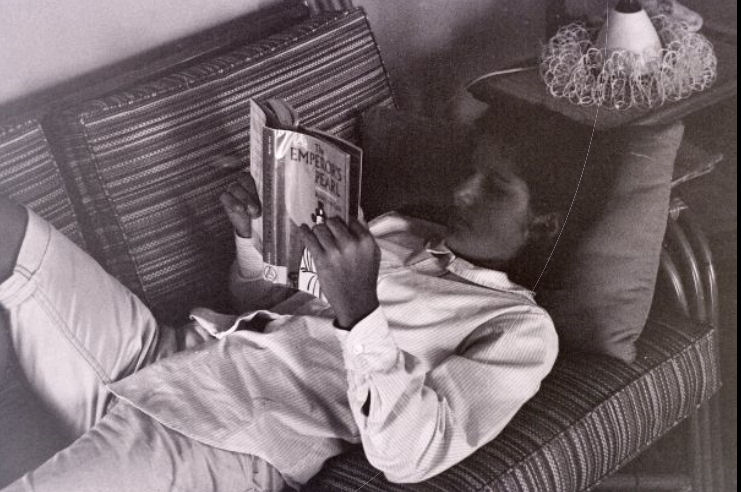
Me, in 1964, reading a Judge Dee mystery: The Emperor’s Pearl.

Around 9AM, I had a nice walk around the neighborhood.  A light breeze carried the scent of honeysuckle and cedar, I caught a whiff of paint as someone spruced up their house, and the smell of freshly mown grass was everywhere.  Hot rubber tire odor crept out from under a pickup while the metal of the engine ticked as it cooled — someone had just come to visit?  A barking Min-Pin fenced in a nearby yard made sure I kept moving along. The neighborhood was a good place to be this morning.

By late afternoon, all that changed.  A full-cloud flash of lightning hurried us into the house faster than we normally went as we called, “See you later, alligator,” to our youngest grandson strapped in his carseat.  He yelled back, “Goodbye, alligator!”  Then the rains came, and are still coming down.  A little while ago I stepped outside to see if the storm had brought any cool air, but had my breath taken away by the humidity. All the humid metaphors apply to the outdoors this evening:  Turkish steam bath, rain forest, soupy air …


This picture doesn’t show fog-in-the-air, it shows condensation-on-the-lens.  The cooler lens of the camera was fogged beyond useful pictures by the moisture in the air.  By the way, the picture is of a geranium in a planter.

I hope this steam dissipates by the time I go out for my walk tomorrow morning.

Writers of writing self-help books, please stop giving out the advice to eavesdrop on those around us when we’re out in public in order to form a good model for writing dialogue.  Eavesdropping doesn’t work.

I have tried eavesdropping multiple times when I’ve been out at restaurants or in stores.  Not only is there almost always music playing, and very loud music at that, but the rumble of ambient noise fills in all the quiet spaces between the words my target subjects are saying.  In restaurants, add the ting, crash and clink of glassware, dishes, and tableware.  The only place I’ve found that I can reliably eavesdrop on people is listening to the characters in television programs and movies, and that’s already dialogue.

In future, admit that eavesdropping is impossible.  It will save those of us trying to develop dialogue a lot of trouble, and we won’t think the rest of your advice is as valid as the recommendation to eavesdrop.

It would make me happy if I could submit manuscripts to publishers again. I don’t need instant success, I  just want to be in the game and fulfill the dream I had at 15 while singing along to my favorite Beatles song, “Paperback Writer.”  I’d be a part of publishing.  All I need to do is get those stories on (virtual) paper, and submit them.  Rejections are part of the process, so even receiving rejection slips would show I was officially working at writing.  Before I do this, though, the computer daemon also demands submission, but submission of a different kind:  apparently as a rite of passage, the word processing program wants me to suffer before it gives up the secret for applying headers on the pages I create.

In order for a writer to successfully storm the transom and convince the publishers’ slush pile readers that a manuscript deserves a second look, any piece she sends them must conform to the standard format. Not using standard format will get your manuscript sent back to you far faster than it took you to write it. Part of the standard format is using headers on each page. Among other things, this allows publishing company minions to reassemble a story if the printed manuscript falls to the floor and the pages scatter.

When I was composing on a typewriter, putting in headers was easy, you typed them at the top of the page before carriage-returning your way down the paper.  Since processing words is now computerized, putting in a header isn’t managed through the simple task of typing.  Yes, in our complex word processing programs the “find and replace” function is marvelous.  Yes, spell- and grammar-check are amazing.  Voice recognition programs save, save, save my wrists.

Up until now I’ve been a successful word processing autodidact, but the basic header is about to do me in:  I can’t get it to work.  Multiple menus are involved; many boxes need clicking; and what you click affects the next action you humbly ask the program to perform.  Also, some buttons are located on ribbons, which has me baffled because the last ribbon I used was in a typewriter.  However, since I’ve made it this far — we didn’t have blogging classes in the 1960s — I’m sure I’ll catch on.

To get myself in gear, and because Word doesn’t come with the much wished for Abracadabra shortcut, I asked friends in one forum for a how-to on headers and received two separate instructions.  The first instruction mentioned the ribbon, and after later watching an online tutorial, I think the ribbon instruction is for Office 2010.  I have Word 2003 (hey, I’m not still using GeoPublish).

The second set of instructions almost worked, except they didn’t because clicking buttons that are supposed to separate the first page from all the others so that page 1 is its own section isn’t sticking. I click for the header to be activated “from this page forward” and with “first page different,” only to scroll back and find the header imprinted at the top of page 1, as still and obdurate as a rock.  The shouting had no effect and the curses aren’t working.

Using the hints my friends supplied, I played around — unfortunately, rather than sorting out my characters’ timings, manipulating the subtleties of scene decoration, or crafting a really brilliant twist — and I did manage to keep the header off the first page with the numbers starting on page 2.  I was so happy.  Then I scrolled down to page 3:  nothing.  Oh, my text was there but pages 3 and 4 of this trial document had no header. The only page displaying a header was page 2, the “from this page forward” page. I did have pages from that page forward, I just didn’t have any headers. The curses still aren’t working as I haven’t yet seen any reports about the programmers of Word 2003 spontaneously combusting.

Part of me figures it doesn’t matter whether I ever learn how to make Word’s headers. At the rate I’m flattening this learning curve, I won’t have to worry about making an incorrect submission because I’ll never again have time to write: I’ll spend the rest of my life figuring out headers. Problem solved.  No writing = no need to submit.

It’s at this point that self-publishing doesn’t sound so bad. I self-indulgently blog, I can self-indulgently publish.  Who cares if I have validation from the minions of a conglomerate whose main interest is the bottom line? Minions begone! If I don’t have to fight with a mute computer program that formats as it pleases, frustrating my desire to please minions, I’m happy.  I just hope that the self-publishing format doesn’t require headers.

———————————————

Update:  Repeating the header insertion on page 3 after inserting it into page 2 kept the page 2 header and also inserted headers on pages 3 and beyond.  Odd, but if that’s what it takes …
The more I read about story theory, the less competent I feel I become.  Decades ago, I was confident I could tell a story; today, I’m not so sure.  Still, the trying of it keeps me off the streets and out of most trouble, so I don’t think I’ll chase off after Chicken #42,567,890.

I’m in the middle of creating new characters for an older story line because the characters I created years ago did not fit parts of the  story theory I’m now learning, and I still want to write about the main character.  The difficulties I had putting stories together for this group may have been because the characters were not as well-constructed as I’d hoped.  Luckily for me, not all of the characters were fatally flawed so I’m not in need of an entire cast.  The setting also stayed the same, so I don’t have to reinvent it as well.

To add to my slowness today in getting down to work making these new characters, I saw a reference to “character flowcharts” in an interview of Meg Waite Clayton, an online SheWrites colleague.  Using flowcharts seems like a natural addition to my notebook-upon-notebook style of composition, but I think flowcharts are more formal than the bubble maps I already use.  I’m not flowchart-trained so the research-junkie part of me went looking for more information.  My first search didn’t produce any links to a useful flowchart/storyline explanation, although I’m not done looking, but I did find a chart of stereotyped female characters.  Humor distracts me every time, and this example at least has one useful path to follow for any of the important women in the stories, and many more to avoid:

Female character flowchart from Overthinkingit.com

Can she carry her own story?  Yes  –> Is she three dimensional?   Yes –> Does she represent an idea?   No –>  Does she have any flaws?   Yes –> Is she killed before the third act?   No –>  Congratulations!  Strong female character

The up-side of of my chicken-chasing today is that the distractions gave me this blog post.  I can check that job off this week’s to do list for writing and get back to inventing people, their world, and the stories about the trouble they get into.

I’m putting this here so I don’t lose it.

The members at Critique.org submit their own work for critique, and read the work of other writers and provide critiques.