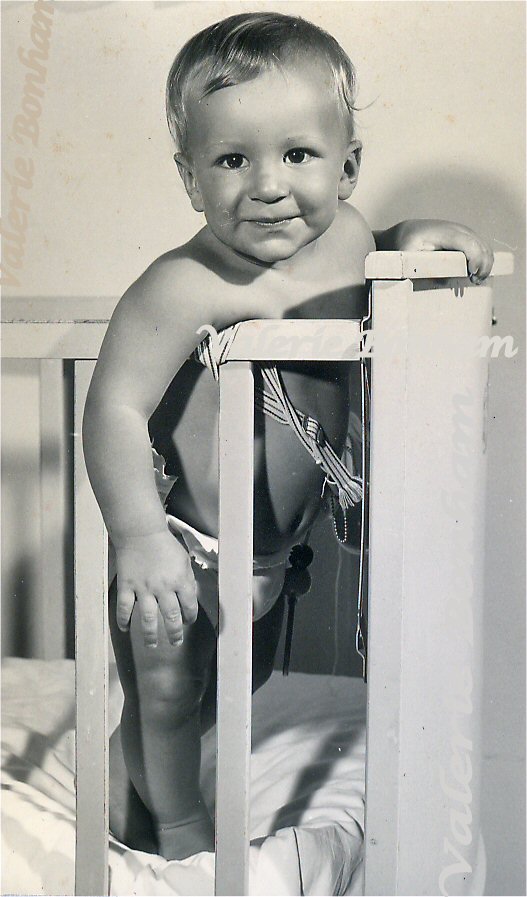
1955 08 Aug 21  in crib

 (my little brother)


Inspired by the choice from the popular television series Sherlock that my daughter and her husband made for the name for their soon-to-be-born son  (and no, they didn’t go with “Sherlock”), I’ve put together a list of baby names from mystery stories with which I’m familiar.  Some names, of course, would have to be for brave and adventurous parents, but the lists should have something for most mystery-loving parents.

Girls

Agatha (call her Aggie), for the Queen of Mystery, Agatha Christie, or Ngaio Marsh’s character, Agatha Troy Alleyn
Amelia, for Elizabeth Peters’s Amelia Peabody books
Anne (Beddingfeld), the sleuth in Agatha Christie’s book, The Man in the Brown Suit
Ariadne, for Agatha Christie’s writer-sleuth, Ariadne Oliver
Barb, for Elizabeth George’s detective’s sidekick, Barbara Havers
Bertha (call her Bertie), for Erle Stanley Gardner’s Bertha Cool/Donald Lam stories
Beverly, for Clair Blank’s young detective, Beverly Gray
China, for Susan Wittig Albert’s detective, China Bayles
Cordelia, for P.D. James’s detective in An Unsuitable Job for a Woman
Eileen, for Agatha Christie’s “Bundle” Brent
Emily, for Dorothy Gilman’s Emily Polifax
Emma, (Mrs. Peel) from the mid-1960s television series, The Avengers
Georgiana, for Rhys Bowen’s royal detective, Lady Georgiana
Goldy, for Diane Mott Davidson’s detective, Goldy Bear Schulz
Harriet, for Dorothy Sayers’s, Harriet Vane
Honey, from the 1965/66 tv series, Honey West
Jacqueline, for Elizabeth Peters’s romantically literary detective Jacqueline Kirby
Jemima, for Antonia Fraser’s detective, Jemima Shore
Minette, for author Minette Walters
Nancy, for Carolyn Keene’s iconic Nancy Drew
Nora, from Dashiell Hammett’s Thin Man books
Precious, for Alexander McCall Smith’s detective, Precious Ramotswe
Prudence, aka Tuppence, from Agatha Christie’s Tommy & Tuppence stories
Susan, for the significant other of Spenser, Robert Parker’s detective/enforcer
Tess, for Laura Lippman’s detecive, Tess Monaghan
Vicky, for Elizabeth Peters’s detective, Vicky Bliss

Boys

Adam, for P.D. James’s detective, Adam Dalgliesh
Archie (Goodwin), the sidekick of Rex Stout’s detective, Nero Wolfe
Cadfael, for Ellis Peters’s Brother Cadfael
Charles, for Simon Brett’s detective Charles Paris
Charlie, for Earl Derr Biggers’s detective, Charlie Chan (meant to counter the “Yellow Peril” Asian stereotype of the time)
Dee, for Robert van Gulik’s detective, Judge Dee (hey, the name works for rocker Dee Snider)
Endeavor, for Colin Dexter’s detective Inspector Morse’s first name
Emerson/Ramses, the son of Elizabeth Peters’s detective, Amelia Peabody
Edgar, for Edgar Allan Poe
Ellery, for the (partnership) author Ellery Queen
Gideon, for John Dickson Carr’s detective Gideon Fell
Guido, for Donna Leon’s happily married detective, Guido Brunetti
Jim, for Lilian Jackson Braun’s cat-sitting detective Jim Qwilleran
Per, for Maj Sjöwall’s partner Per Wahlöö
Perry, for Erle Stanley Gardner’s Perry Mason, of course
Peter, probably the super-name concerning mysteries, for Dorothy Sayers’s Lord Peter Wimsey, Charlotte MacLeod’s Peter Shandy, Reginald Hill’s Peter Pascoe, and authors Peter Lovesey or Peter Robinson
Pierre, for Hugh Pentecost’s detective, Pierre Chambrun
Reginald, Ruth Rendell’s detective, Reginald Wexford, or for the author Reginald Hill
Robbie, for Colin Dexter’s Robbie Lewis, initially from the Inspector Morse stories
Roderick
, for Ngaio Marsh’s detective, Roderick Alleyn
Simon (Templar), for Leslie Charteris’s detective, The Saint
Virgil, for John Ball’s detective, Virgil Tibbs
Walter, for Walter Mosley who writes the Easy Rawlings series
Wilkie, for Wilkie Collins

On the Sisters in Crime email list for “the great unpublished” (Guppies), one of the discussions was how a member discovered Donna Leon’s Inspector Brunetti series that is set in Venice, Italy. I’m a Brunetti fan and I was pleased to see recommendations for books by authors who set their stories in Italy.

The pièce de résistance of the discussion (as far as I was concerned) was the revelation that an Inspector Brunetti television series is available, in German!  (pardon my squeal of excitement)  I now have a list for people-who-give-me-gifts, and am thinking up nine gift-giving days, such as Mother’s Day, my birthday, our anniversary, and Christmas.  I suppose we could add St. Patrick’s Day, the first day of spring, May Day, Hallowe’en and Flag Day.  That makes nine, right?

Again, thanks to the Guppy list and the generous members.

~*~*~*~*~*~*~*~*~*~*~*~*~*~*~*~*~*~*~*~*~*~*~*~*~*~*~*~*~*~*~*~*~*~*

Update

The first two-program Brunetti video set arrived yesterday and I watched the first program, “Vendetta.”  I (along with my three-week old granddaughter) enjoyed the show.  The scenes of Venice were delightful; the characters, although not identical to what I imagined while reading the books, are well-cast; hearing German took me back to Europe; the story was well-produced.  The subtitled were useful for scenes in which the German words weren’t clear, or for dialogue in which I just didn’t know the words. My baby was lulled throughout.

All in all, a success.  I look forward to (eventually) seeing the entire series.

1965: Planes in the backyard U.S. Air Force plane over St. George's Harbour, Bermuda, taken from our backyard on Kindley Air Force Base.

1965: Planes in the backyard
U.S. Air Force plane over St. George’s Harbour, Bermuda, taken from our backyard on Kindley Air Force Base. This plane is the same type as one involved in a crash I heard.

Regardless of the era, military service can be a dangerous line of work. Many military jobs involve either work with dangerous materials or vehicles, or living in an area in which one’s country’s efforts are not appreciated, and it has been this way during the decades following World War II. On one hand there is the point that many of the military actions seem to be imperialistic in nature — “Americanization” — and that we shouldn’t do that. We should stay home, tend to our own knitting.

The flip side to that, from an American viewpoint, is that some country, somewhere, is going to be the ‘leader,’ or perhaps a less domineering view would be the ‘trend setter.’ In any case, one country, or a treaty-bound group, will be the dominant nation. Which country is best suited for that role? Since the top slot will always be ‘there,’ If you don’t want the U.S. to be spending the money, the time, and the people to support the U.S.’s position, which other country do you see as best filling that niche?

Even without a ‘hot’ war in progress, staying alert or supporting other missions have their own dangers, and given the role assumed by the United States of being one of the top dogs in the field of (usually) supporting the downtrodden in many places around the globe, and in the wake of seeing continued deployments to Afghanistan, I was reminded by an article in the Bermuda Sun newspaper of the dangers faced by service members during the Cold War as the newspaper covered the 50th anniversary of an air crash near the island.

Bermuda air disaster, 50 years on, The Bermuda Sun

I well-remember this tragedy because I heard it. I was walking home, probably from the beach on Kindley Air Force Base in Bermuda, and an uncharacteristic boom sounded, as if someone had shot off Anzio Annie, one of the Krupp K5 railway guns used in WWII by the Nazis.

Everyone who lived on Kindley was accustomed to hearing planes as the base was built parallel to the joint military-civilian runway serving Bermuda. We heard everything from Pan Am jetliners, to B-47s, to C-130 Hercules cargo planes, to fighter jets, as well as aircraft whose names I don’t know, and whose job was probably secret. We heard all manner of machines with either propellers or jets, and the runway was so close to everything else, that people could walk along a sidewalk and find themselves behind fighter jets being hit by exhaust. In school, our teachers would pause during lessons when the scream of jet fighters could be heard as the planes hurtled down the runway. Our teachers would wait to continue the lesson until they could once again be heard. Planes were as common, or perhaps more common, than birds.

1965: Kindley AFB, Bermuda Seeing off friends at the MATS terminal, the place where many of us arrived and departed.  In this picture, we're all being blasted by propwash from a Coast Guard plane on which our friend was leaving.

1965: Kindley AFB, Bermuda
Seeing off friends at the MATS terminal, the place where many of us arrived and departed. In this picture, we’re all being blasted by propwash from a Coast Guard plane on which our friend was leaving.

For me, hearing the crash of the two planes, one of which was the same type as the one pictured at the top of this piece, was a reminder of another crash two years before.

U.S. Air Force KC-135 Stratotanker crashes near Spokane, killing 44 airmen, HistoryLink.org

I didn’t live near Spokane, where the crash happened on Mount Kit Carson, but rather at Ellsworth Air Force Base in South Dakota, the place where the flight originated. The fathers of the families of the neighbors directly behind our house and directly in front of our house were both on the plane. The son of the plane’s captain was in my class. Of all the 44 men on the plane, only something like 3 or 4 were single, not that this was any different for their parents and siblings, but only that one or two fewer people on the base were devastated by the tragedy.

The crash at Ellsworth was the first one I remember. It came on the television with no warning and the families had not yet been told. It obviously wasn’t the last one I remember, given the crash in Bermuda, as well as other crashes during our time there. My time with my career-Army husband has contributed more tragedies, such as the Ramstein Air Base airshow Flugtag ’88 disaster that is recent enough to have footage on YouTube, the horrific Lockerbie terrorist attack on Pan Am flight 103, as well as multiple terrorist bombings in the 1970s and 1980s in West Germany.

The effect of the United States military services is far too complex, for better or worse, to be even glossed over in a blog post. All one can do is mention them. The subject is far too complex probably for entire books to sort out. Despite the bad, there is still good, and I hope the people now wearing military service uniforms, and especially the people who continue to be deployed to Afghanistan, are as protected as they can be, that they make the best decisions possible, and even with the odds against this happening, that they all return safely home.
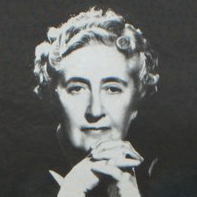
Agatha Christie, courtesy Wikimedia Commons

Agatha Christie, courtesy Wikimedia Commons

In re-reading Agatha Christie’s novels I’m listening to them rather than re-reading them.  I do have all her books, so re-reading all of the stories wouldn’t be a chore for me (the books are the 1990s Bantam collection in blue leatherette, the collection that is so readily available on eBay, and are the books that replaced my paperbacks whose pages were falling out). Still, it’s so much easier to listen to the books while I’m doing other things — we all multi-task nowadays, don’t we.

The novel I’m listening to now is A Murder Is Announced, a story set in the town of Chipping Cleghorn in which a Rudi Scherz apparently tries to murder Letitia Blacklock during an “announced” murder at Letitia’s house, Little Paddocks. In the story, Miss Jane Marple is informally assisting Inspector Craddock in discovering why (the now-deceased) Rudi would do such a thing.

Even though Mrs. Christie is called the Queen of Crime and her books are well-appreciated by readers around the world, I do listen to books other than hers.  One big difference, though, that I’ve noticed between Mrs. Christie’s Golden Age mysteries and many modern mysteries is in reading ease.   Mrs. Christie never confuses me, other than in strewing red herrings throughout the story.  I always know where I am in the story and who is who.

I’ve read the commonplace criticisms of her work: clichés, cardboard characters, and lack of depth.  My own criticism would be the repetition in what the characters are called as she seems to be fond of certain names — Archie Easterbrook in A Murder Is Announced, Mark Easterbrook in A Pale Horse.

Despite the weak spots in the Christie books, a strength I value is Mrs. Christie’s ability to tell her stories in such a way that she doesn’t baffle the reader concerning the story’s narrative, or at least, she doesn’t baffle this reader. Even when I’m not multi-tasking, I appreciate being able to follow a story even if I usually can’t figure out whodunnit.

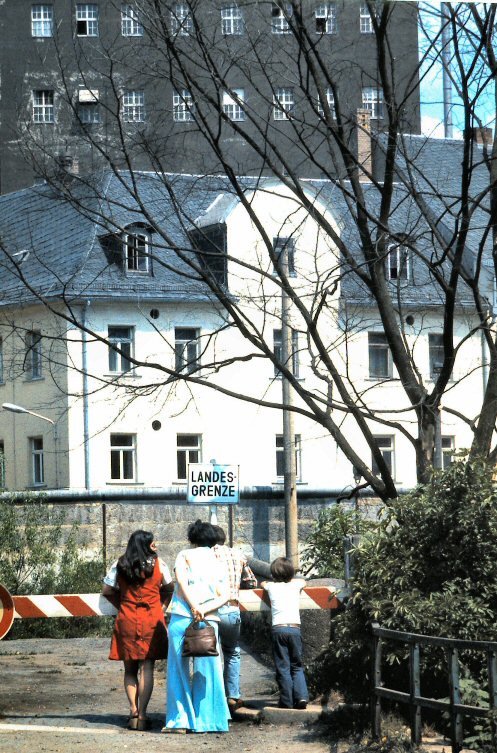
1978: Me, in the red dress, and my son, on the right, with friends, looking across the Saale river into East Germany, near the Bavarian town of Hof.

1978: Me, in the red dress, and my son, on the right, with friends, looking across the Saale river into East Germany, near the Bavarian town of Hof.

German filmmakers are making films depicting life during the 40-year existence of the Deutsche Demokratische Republik, the DDR, East Germany.  Apparently, it’s a space that has been left vacant for the most part.  To quote an NPR review of a recent film, Barbara, a German entry for the Oscars,

“The West kind of got there and said, ‘Now you can be happy.’ … I mean it’s 40 years of their lives. … They can’t be in vain. And no one asked.”

I’ve seen two films about life in the former East Germany after it was “former,” when the life was the life after the fall of the totalitarian Communist regimes in Eastern Europe:  Schulze Gets the Blues and Goodbye Lenin.

Barbara is the first film I’ve watched from the Eastern point of view about how people managed during those 40 years on the other side of the fence.  At the time, no one on this side of the fence imagined they’d ever be a former enemy.

On Netflix, I have just discovered Phryne Fisher.

The first two episodes of the series (all that I’ve seen, at the moment) are of excellent quality, capturing the elegance of the 1920s. I also find the characters to be engaging.  I’m hoping that the books are as evocative.

This Friday is my youngest grandson’s sixth birthday. It will be his best birthday yet, at least according to him, because it will be 13 December! Of course, all his other birthdays have been on the 13th of December, but at the end of this week, it will REALLY BE 13 DECEMBER!

He’s jazzed about Friday as only a six-year-old can be about his birthday.

For his present I’ve bought a few toys, of course. No child’s birthday is complete without toys. The present he probably won’t be expecting is a story, a birthday-adventure story about himself featuring his favorite color (blue), his favorite outdoor game (disc golf), with the story set in his favorite place (Wuhu Island from the Wii Sports Resort game).

In addition to all that, the illustrations are by his 10-year old cousin. I printed out a draft of the story that she read, and then she drew six pictures from the story in one of her sketch books.

2013 12 Dec 08 Drawing for Ems's book 01

In this part of the story, my grandson is working at the Swordplay Colosseum on Wuhu Island. The swordplay game is one of his favorites.

In order to get my granddaughter’s pictures to me, and because our schedules are busy, her mom left the sketch book outside their front door in a Ziploc® bag, and her Poppa swung by to pick it up. I scanned the pictures and saved them to my hard drive so that I can print the pages on photo paper. I’ll mount them back-to-back with spray glue to make strong pages, and then bind them into a book with comb-binding, just like my dad used to do for our family photo albums. It will be a production, but I think the little guy will be pleased with the book.

My grandson reads, but he doesn’t read his grandmama’s blog, so this will still be a surprise, as his birthday is in the story.  Just know that on Friday his cousins and I will be wishing him a very happy birthday.


~~~~~~~~~~~~~~~~~~~~~

Update

My grandson is thrilled with the story — he can’t believe how many people he knows in the story.

Beware the revenge of writers.  We might (eventually) make a profit off your incivility.

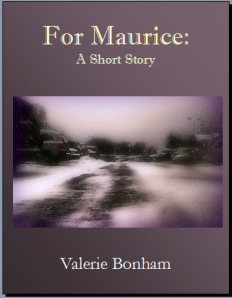
One woman considers breaking the laws of 'victimless' crimes to be something from which she can benefit.  Another woman is merely a thoughtless twit.  When they meet, it can't end well.

One woman considers breaking the laws of ‘victimless’ crimes to be something from which she can benefit. Another woman is merely a thoughtless twit. When they meet, it can’t end well.

Click cover to open file.

One of my pet peeves is stories, whether written or performed, that have incorrect military information.  Some of the wrong information is simple, such as my current peeve, and some of it is illogical made-up-stuff.

Tonight’s irritation is with an episode of “Unforgettable.”  In the story, a Veterans Administration doctor has been asked by Unforgettable’s main character about a veteran who is a person of interest in a murder (the Crazed Veteran is always a popular character if you need a military person in your story).   The veteran in question would be fluent in Pashto, a language in Afghanistan.  The doctor replied to the detective that it would take several tours in Afghanistan for a soldier to become fluent in Pashto, and then says that she does have a client in counseling who fits the description — a corporal.

Insert rant about ‘if you plan on writing about something, learn the basic information about it.’

In the Army, a corporal is an E4, a junior enlisted rank.  If this person were a corporal he wouldn’t have had enough time in service to easily become fluent in Pashto, unless he’d been demoted multiple times.  Pashto is a language that the Foreign Service Institute rates as a level 2 or 3 language, levels that take between 34 – 48 weeks of full-time study for basic proficiency. Unless a person were being trained as a linguist, it is unlikely that the Army would invest the time for the training.

Which brings us to another point.  The photo of the uniformed ‘person of interest’ shows a relatively long-haired white-bread man (for today’s military) in an Army uniform, wearing infantry brass backed by a light blue disc.  An infantryman in Afghanistan is not surprising, however, an infantryman wouldn’t have linguistic training.  If an infantryman had acquired fluency in Pashto — either from multiple tours in Afghanistan or from language training — he would have been in the Army long enough to be more than a corporal.  Still, for story-purposes, a Pashto-spouting bad guy is more menacing than your average veteran.

Then there’s the fiction that he’s a corporal.  In today’s Army, very few military occupational specialties (MOSes — ie, ‘jobs’) use the rank of corporal.  An E4 in the infantry would be a specialist unless he were filling a leadership position.

Specialist is a designation retained from when the Army had ranks from Specialist Fourth Class up to Specialist Seventh Class alongside the NCO ranks of the same pay grades.  In today’s Army, and of the specialist ranks, only the E4-Specialist rank remains.  I’d say this story character wouldn’t be a corporal because, as I said before, if he’d been in the Army long enough to be fluent in Pashto, he was probably demoted more than once and wouldn’t be leader material.

Now if this service member were a Marine, then the corporal rank is appropriate — although, as a Pashto-speaking-E4, he still would be suffering from the time-in-service problem concerning the language fluency.

The holes in this one story point are large enough to drive a truck through.

Writers — and producers and directors — if you’re going to use the Crazed Veteran character in your stories, at least do the poor guy the honor of getting his backstory straight.

When you’ve collected lots of books, it helps to have a system for organizing them — if you can’t find what you’re looking for, what’s the use of having it? I often sincerely wonder how people who live in very large houses find things — who keeps track of all the *stuff* that goes into furnishing large spaces?

In organizing my books I chose not to reinvent the wheel.  Someone had already done the groundwork of sorting-subjects, so why not use an existing system?  As for which system, I chose the one most familiar to me, the Dewey Decimal system.  I’ve read that it isn’t as detailed as the Library of Congress system, but as I’m unfamiliar with that system (no college for you, little girl!), I stuck with what I know.

The entire house isn’t rigorously organized as a library — I like to know where things are, but I’m not a rigid purist by any means.  Still, I have them all sorted: mysteries are in the bedroom, writing books are in the writing room, nonfiction is in the three large bookshelves in the basement, general fiction is in the entryway, children’s fiction is in the spare bedroom, cookbooks are near the kitchen, religious studies are under the knickknacks (no connection intended, it’s just where there was room), cartoon books are in the bathroom, and the Agatha Christie collection has a place of honor alongside the Junior Deluxe Editions children’s classics my parents collected when I was a kid.

Thanks to Mr. Dewey, I have a general idea of where to shelve books, but every once in a while a book stumps me.  Years ago a friend gave me a Dewey Decimal Classification book, but working through it to figure out where a book belongs when the classification isn’t obvious can take some time because, in a microwave/Internet/text messaging world, divining library classification entrails is something to be undertaken on a grey, slushy winter day with a cup of cocoa, and that isn’t today.

The book that flummoxed me this morning was CID: Army Detectives in Peace and War.  The press that published it didn’t add the classification numbers I usually rely on (thank you, modern publishers!).  This led to an Internet search — long story short, good old OPAC has it listed at the Ft. Leonard Wood library.  I haven’t regularly used OPAC since we lived in Belgium, so that was a fun trip down memory lane.  I now have the book classified at 355.1, which will put it at the far left end of the shelf of writing books with their 800s numbers.

Sorting books may not be everyone’s cup of cocoa, but if you want to find what you’ve squirreled away, having the books organized is the way to go.

It also gives the kids something benign to share as their penance for having been born into this family.