Non-fiction day


On this day in 1976, the world watched as a drama unfolded at the airport in Entebbe, Uganda.  Two days before, on 27 June 1976, an Air France airbus took off from Tel Aviv for a regularly scheduled stop in Athens while en route to Paris.  Among the passengers boarding the plane in Athens were four people whose plan was not to arrive in Paris and go about their business, but rather to skyjack Flight 139 once the plane was in the air, force the pilot to change the flight destination, and to use the passengers as bargaining chips.

The plane landed in Benghazi, Libya and then went on to Entebbe, Uganda.  On today’s date, Flight 139 sat on the tarmac in Entebbe.

Two of the four thugs who hijacked the plane were post-war middle-class Germans, “Hitler’s Children — angry young people of university student age lashing out at their parents’ generation.  When the ignominious ‘end’ of American participation in the war in Vietnam left these angry ’60s rebels without a reason to kidnap and bomb those whom they blamed for their anger, they claimed solidarity with the Popular Front for the Liberation of Palestine (PFLP).  Two PFLP members participated in the skyjacking as well.

This skyjacking was the fourth one of 1976, and four more planes would be attacked before the year was out.  It was a harrowing time to fly*.  On this day, though, the world watched as thugs demanded that governments  free specific prisoners in Israel, Kenya, France, Switzerland and West Germany.

In Entebbe, the hijackers released the non-Jewish passengers, but, with the cooperation of the Ugandan military, continued to hold the passengers carrying Israeli passports.  Some of the older Israeli passengers were survivors of Nazi concentration camps and were now forced to relive that nightmare, complete with German voices.

After being freed, the non-Israeli passengers were flown to Paris where they were debriefed.  An Israeli strike force used this information to create a rescue plan.  A long week after the skyjacking, the world found out that Israeli commandos, under the command of Lieutenant Colonel Yonatan Netanyahu, brother of the current Israeli Prime Minister, had stormed the plane and rescued most of the hostages in a shootout with the now-dead thugs. Tragically, Col. Netanyahu and three of the hostages were shot and killed during the rescue.

The last victim of the skyjacking was Mrs. Dora Bloch, a British citizen who lived in Tel Aviv and was traveling to her son’s wedding in New York.  While she was a hostage, Mrs. Bloch had been allowed to leave the kidnap scene to go to a hospital.  After the Israeli rescue of the hostages, infuriated Ugandan soldiers apparently took revenge on her.

The Entebbe skyjacking was almost immediately memorialized by the movies Raid on Entebbe (movie at the link), Victory at Entebbe, and Operation Thunderbolt.  A later production was Six Days in June and the book Israel’s Lightning Strike.

ΞΞΞΞΞΞΞΞΞΞΞΞΞΞΞΞΞΞΞΞΞΞΞΞΞΞΞΞΞΞΞΞΞΞΞΞ

* The skyjacking was personally affecting as it happened while I was waiting, with our young son, to join my husband who was in West Germany with the U.S. Army. Military families are often separated, usually because of the scarcity of housing, when the service member is reassigned. The family waits somewhere — either at the place they’re leaving, or perhaps with family — until living quarters become available or until the service member finds a rental home.

The personal part of this event only comes in because the news increased my nervous anticipation about the journey. Even if you were taking a domestic flight, you never knew if you’d make it to your destination, or wind up in Cuba. Between the time of the Entebbe skyjacking and our flight to West Germany, three more planes were skyjacked, to include a TWA flight leaving from New York, six days before our flight from JFK.

  • 25 January 1976:  El Al Boeing 707 (missile attack)
  • 7 April 1976: Philippine Airlines (PAL),BAC One -Eleven
  • 21 May 1976:  Philippine Airlines (PAL),BAC One -Eleven
  • 23 August 1976:  Egypt Air, Boeing 737
  • 5 September 1976:  KLM flight 366
  • 10 September 1976:  TWA flight 355
  • 6 October 1976:  Cubana Airlines flight 45

Although we weren’t hijacked, our journey that September was fraught with tension. TWA’s employees went on strike the night before our scheduled flight and I was on the phone until about one in the morning rescheduling connections. The shuffling of TWA passengers onto other carriers made for crowded and delayed flights and our cat (yes, our cat) and our suitcases missed flight after flight that day, to include the helicopter hop from LaGuardia.

Because of these delays, we missed our flight to Frankfurt and were stranded at JFK.  One of the Army liaisons took pity on us and drove us to Ft. Hamilton to stay in the transient facility.  He kept our cat overnight.  The next morning he drove us back to JFK and we camped out in a hallway, waiting for standby seats to become available.

Eventually, we arrived safely in Frankfurt, just at the moment my husband returned to work after sitting at the airport with no news of us. I had asked someone, anyone, at Pan Am to notify their desk in Frankfurt, but, yeah, that didn’t happen.  After driving two hours to Frankfurt, waiting for six hours, and driving two hours back, my husband had to drive to Frankfurt again.  Let’s just say he wasn’t in a good mood when we met.

In my defense, calling West Germany from a civilian pay phone in New York and connecting to a military phone number wasn’t an easy task. The phone systems were almost incompatible — you had to use human operators — and pay phones took only coins. People answering military phones aren’t allowed to accept the charges on collect calls. I wasn’t traveling with sacks of quarters, and large amounts of change weren’t easy to come by.

Our family was lucky in that in our 30 years of military travel no flight we were on was skyjacked or blown up.  God rest the souls of the victims of the Lockerbie bombing and Korean Air Lines flight 007.  I’m thankful that my worst adventure involved only my mad dashings that day through Chicago’s O’Hare terminal, and our stranding at JFK.
I was just reading an update from another blog in which the author mentions one of his long-time series characters.  I read the character’s name but what popped into my mind wasn’t a character but the face of a pug.  The character’s name reminded me too much of the so-stupid-it’s-funny “ermahgerd” meme.

“Ermahgerd” (oh my god) recently popped up on the LOLcats site, and then spread.  I don’t think it’s got quite the “legs” of most LOLcat-speak such as “can haz” or “teh internets,” but it made enough of an impression so that when I saw a long word beginning with E and having the same number of syllables as ermahgerd, my brain skipped from book-character to silly-pug-face.  I thought my guilty LOLcat addiction was under control.

I suppose it’s a lesson in being careful what you let into your brain.  Eradicating silly memes is as hard as getting rid of poison ivy.

It’s easier than noveling.

A blog for EQMM!  Something Is Going to Happen

In years past, my routine fix of EQMM arrived (eventually) in the mail via the Army APO system.  Those of us who spent many years overseas were resigned to all of the American magazines to which we subscribed appearing in our boxes at the mailroom long past the same magazine’s arrival in the Stars & Stripes bookstore.  Periodicals in the U.S. are not priority mail and are sent to overseas subscribers in bulk.  Those shipments can sit for a while, depending on the available transport space.  Still, those of us who subscribed to magazines kept our subscriptions in order to receive all of the issues (or at least most of them) and not just the ones we happened on when we visited the bookstore.

Fast-forward a few decades and now all we have to do for a quick fix is click a link.  Ain’t technology (usually) grand!

Hat tip for the information to Terrie M. at Women of Mystery.

Although the mystery convention, Malice Domestic, has been around for 24 years, this is the first time I’ve attended.  Despite being a life-long mystery reader (I count my early reading of Rupert the Bear stories because Rupert always had some kind of mysterious problem to solve in each story), our family had left Maryland by the time the convention was founded and were in Europe.  After we moved back to America, kids and caring for my (late) mom took up our time.  I must say that although I’ve missed all Malices up ’til now, my experience hasn’t been ruined by waiting.

Today, for instance, I not only saw Elizabeth Peters (!!!) roasted (in the most honorable way), but she kindly signed books and I briefly spoke with her.

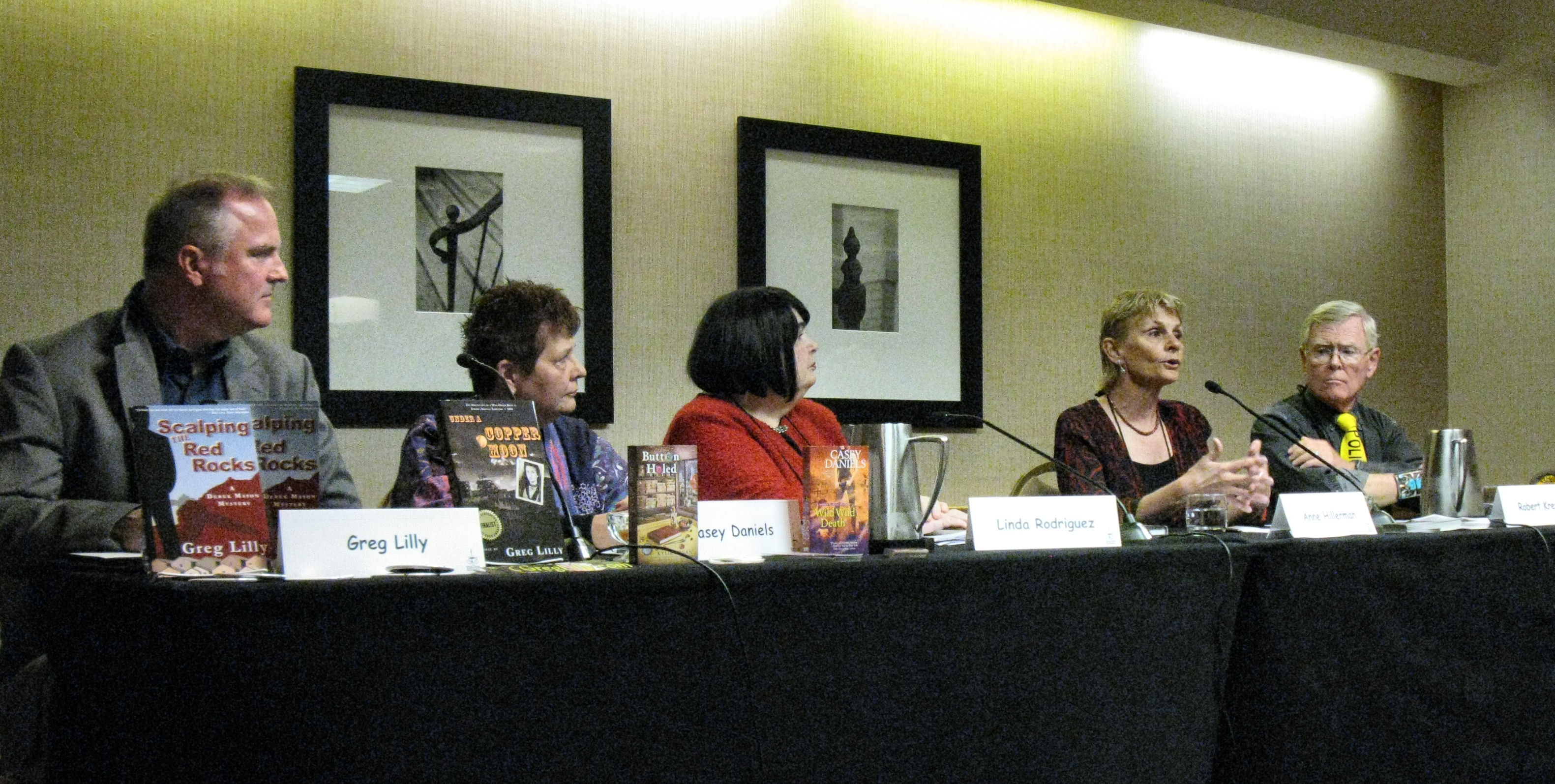
Watching a local friend, Linda Rodriguez, moderate the panel “Have gun, will travel:  Mysteries set out West,” with authors  Greg LillyCasey DanielsAnne Hillerman and Robert Kresge, added a cherry to the banana-split-thrill of seeing Ms. Peters.

On an everyday level, I’m tickled that Dodie R., a former coworker of my husband from our years in Germany, is a devoted Malice attendee.  She and her friend Mary A. have kept me company during more than one meal.

To say I’m happy to be here may not be on the level of “I enjoy breathing oxygen,” but it’s the most fun, barring grandkids, I’ve had in a long time — I voted for the Agatha awards!   I’m tickled.

In almost any type of how-to article or book, readers will find lists of what to do and what to avoid.  If you want to succeed at whatever the expert is advising you about, do this and don’t do that.

  • runners must wear the correct shoes
  • painters need the right brushes
  • cooks should use thick, solid pans
  • gardeners ought to test their soil

Writing instruction comes with similar guidance.

In a new article from Writer’s Digest, ten writers examine ten well-known rules. I was pleased to see I own books from three of the experts, James Scott Bell, Natalie Goldberg and Donald Maass.

The rules they analyze, and give both pro and con opinions about, are:

  1. Write What You Know.
  2. Hook Your Readers on Page 1.
  3. Show, Don’t Tell.
  4. Write “Shitty First Drafts.” (Really, do you have a choice?)
  5. Write EVERY DAY.
  6. Kill Your Darlings.
  7. Develop a Thick Skin.
  8. Silence Your Inner Critic.
  9. Read What you Like to Write.
  10. If You Want to Get Rich, Do Something Else.

My own short viewpoints on the rules are:

  1. Write about what captures your attention.
  2. Make page 1 as interesting as possible.
  3. Show for depth, and tell for speed.
  4. Don’t allow foolish errors in your first draft; you may overlook them in revision.
  5. Increase your word count every day you’re able.
  6. Write your best, but don’t make one section gorgeous at the expense of other parts.
  7. Use your sensitivity to improve your writing, but remember it’s only writing.
  8. Make an appointment with your inner critic.  Later, let her do her best to improve the piece.
  9. Read.
  10. I already didn’t amass riches doing “something else,” so you’ll have to look elsewhere for advice about #10.

Without guidelines, projects wouldn’t be well-built.  Houses aren’t constructed without blueprints for the builders.  Appliances aren’t assembled without schematics for the machinists. Creatures don’t grow without DNA to guide the cells.  That said, there’s always room for evolution and innovation, so use the “rules” as guidelines, then experiment and evolve.

Click on over to the article to read what the Real Experts say.

I’ve been busy elsewhere with fallout from Learning by Grace, Inc., et al, v. Idoni, an artifact from my other life, so I haven’t been blogging about stories, writing, or the audio books I’ve been entertaining myself with, the most recent being Anteater of Death (a cozy mystery set in a zoo) and Foul Matter (a wicked take on the publishing industry by Martha Grimes, with the best hit-men evah!)

A link this morning from one of the writers at SheWrites, though, gave me the opportunity to do a quick link to a piece whose subject is one I’ve thought about:  ‘staying in touch online,’ in contrast with the memory of long days of relative solitude, ie, Before the Internet (BI).

  • Jonathan Fields:  “Creative Kryptonite and the Death of Productivity”
    Hyperconnectivity requires a massive volume of switchtasking, which destroys true-productivity and efficiency because every time you page through your various modes of connectivity and respond to different prompts, you lose focus. To regain that focus requires a certain amount of time and cognitive effort.

I’m sure part of my BI wistfulness is nostalgia for youth. When things were slower I was a hell of a lot younger and didn’t have as many ‘things’ to do to maintain a normal-appearing life — hair color?  every three weeks? (and no, you don’t have to point out that not only is haircoloring optional but the salon is, too; I get that). But wistful nostalgia aside, I used to get more actual activities done, although I doubt that with four kids, two cats, and a dog, I’d have spent much time online, if we’d had an “online.”

Mr. Fields’s blog post has more to it than mourning a BI life in which the most common non-person-in-front-of-us interruption was the telephone.  Then, phones were stuck to the wall so you had to be near one for it to interrupt you, and unless you had one of those long cords, you had to stay within, say, four feet of the phone to continue to use it, as did anyone who called you.   About the only wireless devices for everyday people were CB radios or walkie talkies, and you could tell who had in-car telephones from the whip antenna tied in a curve from the trunk to the hood.  Cool.

Wistful nostalgia aside, read on at the link to Mr. Fields’s blog to find out about “intermittent reinforcement,” and the “Zeigarnik Effect.”

For me, it’s back to the electron mines.  Tschüss.

It must happen with every generation that the icons and heroes of one’s youth (or younger years) die.  Even though we’re all perfectly aware that no one goes on forever, each announcement is a shock.  I’m guessing that in their later years, the actors and actresses slow down, and not as many acting roles come their way.  Poor health might also keep the spotlight from continuing to shine on them, so they fade from view.  Then comes the press release that they’re gone.  Each time it happens, we feel the loss of another cultural touchstone.

This time we lost Peter Falk, so famous as Columbo.  My condolences to Mr. Falk’s family.

Around 9AM, I had a nice walk around the neighborhood.  A light breeze carried the scent of honeysuckle and cedar, I caught a whiff of paint as someone spruced up their house, and the smell of freshly mown grass was everywhere.  Hot rubber tire odor crept out from under a pickup while the metal of the engine ticked as it cooled — someone had just come to visit?  A barking Min-Pin fenced in a nearby yard made sure I kept moving along. The neighborhood was a good place to be this morning.

By late afternoon, all that changed.  A full-cloud flash of lightning hurried us into the house faster than we normally went as we called, “See you later, alligator,” to our youngest grandson strapped in his carseat.  He yelled back, “Goodbye, alligator!”  Then the rains came, and are still coming down.  A little while ago I stepped outside to see if the storm had brought any cool air, but had my breath taken away by the humidity. All the humid metaphors apply to the outdoors this evening:  Turkish steam bath, rain forest, soupy air …


This picture doesn’t show fog-in-the-air, it shows condensation-on-the-lens.  The cooler lens of the camera was fogged beyond useful pictures by the moisture in the air.  By the way, the picture is of a geranium in a planter.

I hope this steam dissipates by the time I go out for my walk tomorrow morning.

Me “talking to myself in the past.”  Talk to yourself, too.

  • How to steal like an artist (and 9 other things nobody told me)

    The question every young writer asks is: “What should I write?”

    And the cliched answer is, “Write what you know.”

    This advice always leads to terrible stories in which nothing interesting happens.

    The best advice is not to write what you know, it’s write what you *like*.

    Write the kind of story you like best.

    We make art because we like art.

    All fiction, in fact, is fan fiction.


Much more at the blog.  Click on over.

« Previous PageNext Page »